The war in Ukraine sent fuel prices soaring and worsened the driver shortage. And a surge in the demand for EVs brought Tesla to Europe with its need for a dedicated fleet. The future looks uncertain. It’s challenging to predict what will happen, but we can look at trends for a best guess.
In recent years, the transport industry’s journey has mirrored an American roller coaster – highs and lows with unexpected twists and turns. Automotive logistics has been at the centre of this ride.
Picture this: the near collapse of numerous car transporters, followed by a sudden surge in demand. It’s a story of resilience. The pandemic led to an unprecedented shortage of semiconductors that halted factory production and turned simple border crossings into complex puzzles. The war in Ukraine sent fuel prices soaring and worsened the driver shortage. And a surge in the demand for EVs brought Tesla to Europe with its need for a dedicated fleet. The future looks uncertain. It’s challenging to predict what will happen, but we can look at trends for a best guess.
Shedding some light through surveys and trends
A recent Automotive Logistics magazine survey painted a vivid picture of the current situation: car transporters are grappling with driver shortages, markets are volatile, and digitalisation and fleet modernisation are creating challenges. To understand this complex situation, we need to separate this into two areas: operational costs and market demand for new vehicles.
Operational costs soar
PricewaterhouseCoopers concluded in one of their studies that the operation costs of finished vehicle logistics suppliers has jumped by 23.1% since 2019. They have developed an FVL costs index that includes various elements, and you can monitor it on their page. The most influential one is inflation, which skyrocketed in 2022. In addition, following Russia’s invasion of Ukraine, import costs surged, leading to double-digit inflation in euro areas as companies passed on more than this direct cost increase to consumers (IMF). Since then, inflation has declined, but it will only reach its 2% target when labour costs eat up corporate profits.
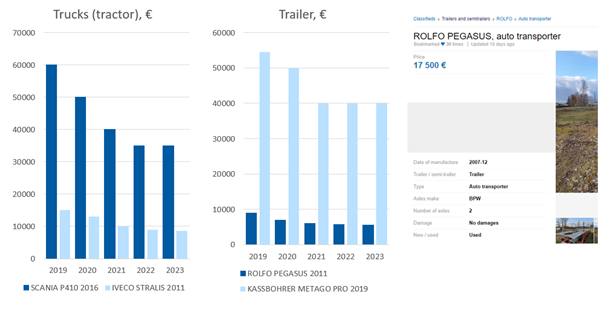
Furthermore, rising fuel costs almost doubled over 12 months in 2022. The diesel price started to fall to its previous level, easing the pressure on haulers in the first half of 2023. The drop was short-lived though as the two leading producers of oil, Saudi Arabia and Russia, decided to limit an outpost. The unrest in the Middle East means that car carriers will have to endure increased diesel prices for another year.
Younger generations turned off by careers in haulage
Did you know that salaries in the transport industry increased by 5.5% in 2022, above the EU average (Eurostat)? Despite this, the younger generation still doesn’t find being a driver an attractive proposition. A recent study by IRU revealed an urgent need for 400,000 drivers in Europe right now. 30% of current drivers will unfortunately retire by 2026, and there are four to seven times fewer young drivers aged 25 or younger who could take over their roles (IRU). Another EU study found that 14% of driver positions still need to be filled. The automotive logistics sector is also struggling, with 74% of respondents in the Automotive Logistics Media survey indicating driver turnover as a primary concern. However, the same survey found that 34% of respondents plan to increase their fleets despite the driver shortage.
There are some small positives – we saw negative growth in merchandise trade volumes for the first time in the first quarter of 2023 (WTO). This may mean less demand for general truck drivers who have licences but no car transporter experience.
Market demand
The demand for new vehicles in Europe goes beyond the number of cars manufactured. Understanding demographic challenges and transitioning to EVs is crucial for the future of the automotive industry.
Fading demand
It’s been a wild ride for the automotive industry in Europe! While there has been a significant increase in the production of passenger cars in recent years, with a massive 25.9% surge in 2023 compared to 2020, these figures are still 84% lower than pre-pandemic levels (ACEA). It’s no secret that the future of the automotive industry seems uncertain because the overall growth of passenger cars manufactured in Europe has been negative for over two decades (Eurostat). Why is this happening? Let’s explore a few of the most likely explanations.
Population of target buyers slowly decreases
To begin with, we need to address the demographic situation regarding new car buyers in the European Union. According to Eurostat, the average age of a new car buyer is 54 years old. The youngest buyers are in Spain, with an average age of 49 years old. You likely bought your first new car when you were 30 years old or older. Eurostat numbers may only provide part of the picture as they do not account for new vehicles purchased by leasing companies.
The target audience for new car buyers is between the ages of 25 and 49. People in this age range typically buy multiple new cars over 25 years. In the EU, there are 144 million people between the ages of 25 and 49, the target audience for auto manufacturers. And guess what? There are 20% fewer people aged between 0-24 years in the EU, which means that the population of target buyers for auto manufacturers is slowly decreasing.
Migration to electric vehicles accelerates
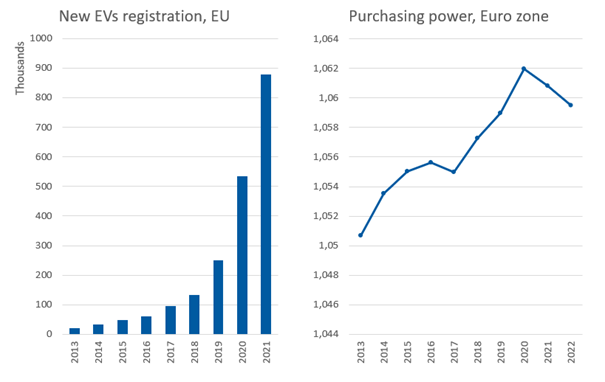
The registration of new electric vehicles (EVs) jumped by 64.8% in 2021. New EVs are like iPhones – everybody loves to own one. But, as with the iPhone, owning an EV comes with a higher price tag compared to traditional internal combustion engine cars. For instance, a VW Golf with essential equipment costs around 26,000 EUR, while a similarly sized EV VW ID3 costs 34,900 EUR – a 30% difference! This is mainly due to the cost of lithium batteries.
Despite the high cost, many EU countries have launched initiatives to ban ICE vehicles in cities by 2030, as EVs are much better for the environment. However, the high price of EVs means that some consumers may not be able to afford them, especially when purchasing power is dropping for the second year in a row.
There is a widespread opinion that while transporting EVs carries some unique risks, they are not inherently more dangerous than internal combustion engine vehicles. In the past, we used to see collisions or ballast issues with Ro-Ro vessels. Now, the media is dominated by incidents of fire abroad Ro-Ro vessels. All that ended in the famous Sincerity Ace sinking in the Atlantic Ocean or the Fremantle Highway disaster.
The road ahead
Automotive logistics service providers will have to deal with rising inflation, fuel and equipment costs, figure out the shortage of drivers, and brace for an uncertain future for the automotive industry. The Automotive Logistics magazine survey cited earlier revealed that 44% of respondents expect freight rates in automotive logistics to rise by 10 – 25% next year.

Gediminas Dauksa
Group Practice Leader Transportation & Logistics
T +370 616 08451
AI agents, Our Friends and Our Enemies
AI agents are being used increasingly, promising ever greater automation of work processes. We hear about their positive impacts in the workplace daily – and rightly so.
Superyacht Insurance: A Deep Dive into Protecting the World’s Most Prestigious Vessels
Insuring a 50-meter (or larger) vessel brings an entirely new set of risks, rules, requirements, and expectations.
Key Actions for CFOs: Addressing Risks in the Middle East Conflict
This article provides a concise overview of the critical areas finance leaders should review to ensure that emerging risks are properly understood, documented, and, where possible, transferred.