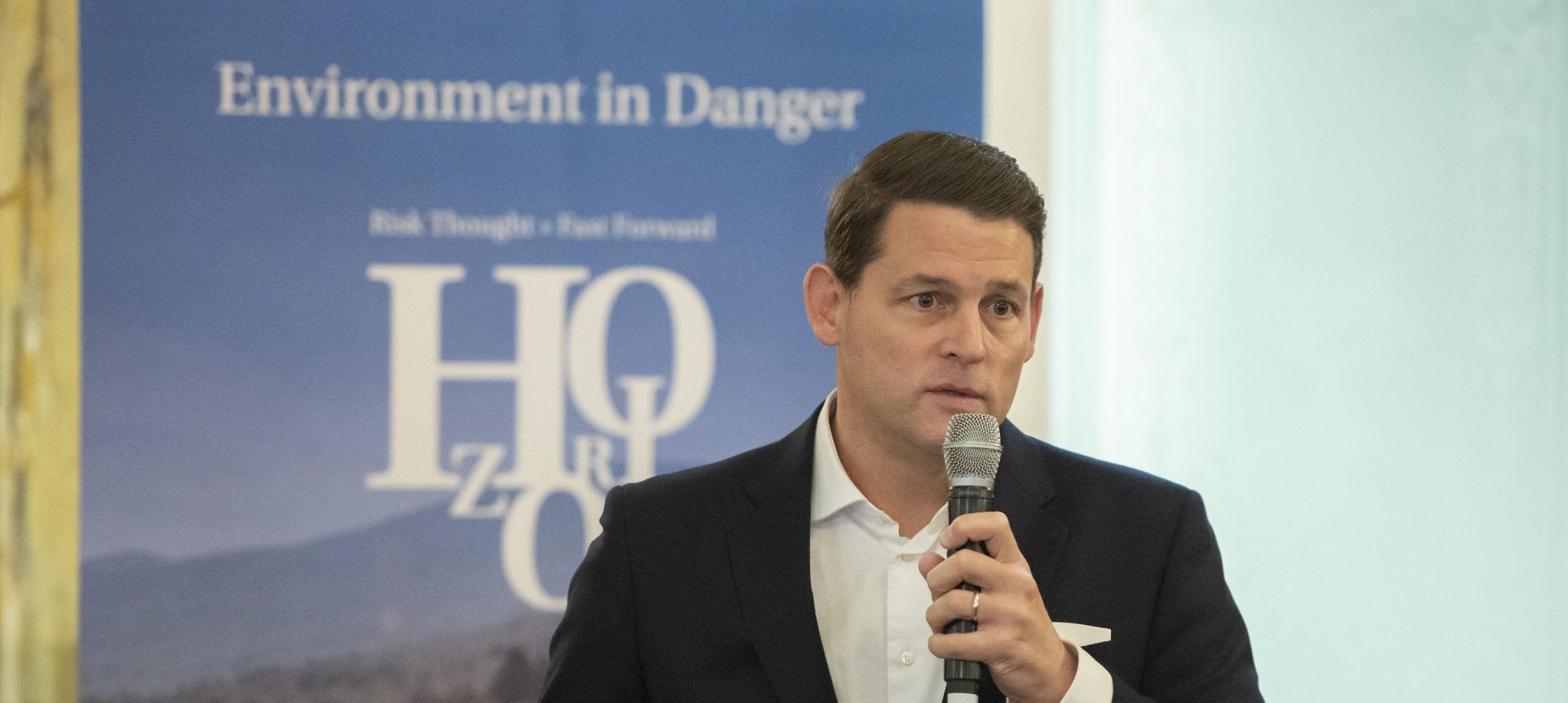
Georg Winter, GrECo CEO, talks about opportunities, risks and setting the course for the future.
Original article written in German by Peter Semplemann, trend. Read here.
trend: Mr Winter, GrECo sees itself as a risk and insurance specialist for industry. What exactly does that mean?
Winter: The company was founded as an insurance broker. Insurance is a classic, impact-related tool: The damage occurs, the risk remains, but its impact is mitigated by the insurance. However, insurance is only one part of risk management. Risk management takes place in several stages. We take a close look at the current and future risks of our clients and how we can not only insure this risk, but also manage it. This begins with avoidance or minimisation.
trend: What is the biggest challenge here?
Winter: Risk avoidance often requires technical, strategic, or organisational steps. Our risk engineering unit deals exclusively with how risks can be optimised technically or organisationally. We also offer cyber security consulting via another subsidiary, Certainity. This is also a very important topic because insurability in the cyber sector is very limited.
trend: Cyber-attacks are a new risk for companies, but insurance against them is just as new. They are an example of the new threats that companies are constantly facing. Can such new risks be insured at all?
Winter: We have been observing a transformation of the risk landscape over the last few decades. In the 1970s, the top assets of companies were still tangible assets, factories, buildings, machines, etc. There were classic risks such as fire, theft or flood which were insurable with classic products. Today, however, company values often consist of over 90% intangible assets – brand values or data. These can only be partially covered or protected by insurance. There are few corresponding insurance solutions for this. In addition, there is always a residual risk. You must be aware of that.
trend: The challenge then is to calculate the residual risk correctly?
Winter: Companies find it particularly difficult to deal with risks that they cannot grasp – I call them abstract risks – which include transformation risks and future risks. The assessment and evaluation are accordingly incorrect and therefore also that of the residual risk.
trend: What do you think of when you talk about transformation and future risks?
Georg Winter: We have categorised them into ecological risks, technological risks, social risks and geopolitical risks. In each case, there are primary and secondary risks.
Climate change is one of the ecological risks. Primary risks here include, for example, an increasing risk of flooding or a period of drought. Whilst secondary risks include transformation risks that arise from capitalising on business opportunities resulting from the transformation. We are focusing very strongly on this.
Sustainable business is an important process, but it also always leads to new risks. For example, when oil or natural gas is replaced by hydrogen in a production process, you have a completely different risk. Or when a photovoltaic system is installed on the roof of a company building. The systems are good and important, but they pose a new risk that was not previously considered with regards to fire protection.
trend: The ecological risk is also more widespread because you can’t estimate how the legal regulations, for example on CO2 emissions, will change.
Winter: Climate change is not something that can be cleared away. It is a fact. Reinsurers are also dealing with it very intensively. Our task is to bring this awareness closer to the companies. The difficulty is that the issue is approached in a very regulatory way, which gives the topic of sustainability a negative connotation: You have to produce reports and there are threats. As a result, sustainability and climate protection are often perceived negatively by companies. Yes, there is a risk that the mood will go in the wrong direction and that companies don’t see it as an opportunity, but only as a burden and a cost factor.
trend: Shouldn’t the first step therefore be to analyse the opportunities before analysing the risks?
Winter: That’s exactly it. And that doesn’t happen enough. We are therefore also trying to put a positive spin on the topic of insurance. In the past, insurance was always a game of fear: there could be a fire – you need fire insurance. We must get away from that. Risk has an attractive sister, and that is opportunity. When we look to the future, we always look towards opportunities. But it is human nature to think about risks. In companies, too, risk is always valued more than opportunity.
trend: Are companies perhaps too strongly rooted in the present? Shouldn’t business models be adapted further to meet future challenges?
Winter: That’s right. Companies are always concerned with risk identification, with the current risk situation. Business processes are analysed and events are assessed according to their impact and probability of occurrence. However, this approach completely ignores the future. Today, you have to look much further into the future and make a risk forecast as part of the risk identification process. For example, how do you transform a company towards a circular economy or to achieve a certain recycling rate, and then how do you draw up a transformation roadmap for this? It’s high time we did this. We need to prepare ourselves to look at how we can safely organise these future business models.
trend: This requires strategic and long-term thinking. A discipline and skill that companies need to develop more strongly.
Winter: You must act and not react. That is also one of our principles. It’s also about anticipating, recognising, and identifying opportunities and risks that are on the horizon or beyond the horizon and then taking the right measures. And about not shying away from transformation. Practising change management in good time. Initiate a transformation and seize the opportunity when you recognise it. Not just when the hat is on fire!
trend: One of the biggest challenges for the economy is demographic change, the worrying population trend.
Winter: The labour shortage in Austria is bad, but it’s even worse in Eastern Europe. In some Eastern European countries, such as Hungary, Ukraine, Romania and Bulgaria, the population decline over the last 30 years has been even more striking than in Western Europe. In these countries, the population is shrinking at double-digit rates. At the same time, the political conditions there are still not ideal. There is no room for young talent. The young are leaving.
trend: And how is the economy reacting?
Winter: The problem is still generally overlooked. Especially in Eastern Europe, where many Western companies have invested. Austrian, German, French or American. 10, 20, 30 years ago, labour was cheap there. Today there is none left.
trend: But we can’t stop the shortage of skilled labour and demographic change.
Georg Winter: But we can act in an opportunity-orientated way again. Companies can show how they can make themselves more attractive as employers by offering benefits, for example. We also offer mentoring programmes for this purpose.
trend: Would it be helpful to offer more career opportunities to workers in the respective countries?
Winter: Exactly. That was also the reason why we set up the GrECo Foundation around 30 years ago. The purpose of the foundation is to promote educational projects in Central and Eastern Europe. We don’t want to be colonisers there and exploit Eastern Europe, we want to develop these markets together. Giving local people opportunities. And when employees and managers from different countries make a career in the Group, this also increases diversity. And all studies show this: The greater the diversity, the more creatively successful the companies are.
trend: Do we need a new culture of opportunity for the challenges of the future?
Winter: I understand this as agility. For me, it means getting out of the silo and taking off your blinkers. Having an open mind, seeing the opportunities. That’s also important for every manager. Because that’s exactly what leadership is: you also have to make the right decisions in difficult situations – not just in good weather.
trend: Is there perhaps too much pessimism about the future?
Winter: We are being hit by risks from all sides. But from a global perspective, life is much better for most people than it was 50 or 100 years ago, yes, there are challenges. But that doesn’t mean we should bury our heads in the sand. Managers must set an active example. Show leadership, focus on opportunities. Whatever the new demands.
About the author
Peter Sempelmann, born in 1968, has been working as a journalist specialising in business and technology since 1997 and has headed the trend. online editorial team since 2013. Stations in his journalistic career: trend, FORMATrofil, WirtschaftsBlatt, Report Verlag.
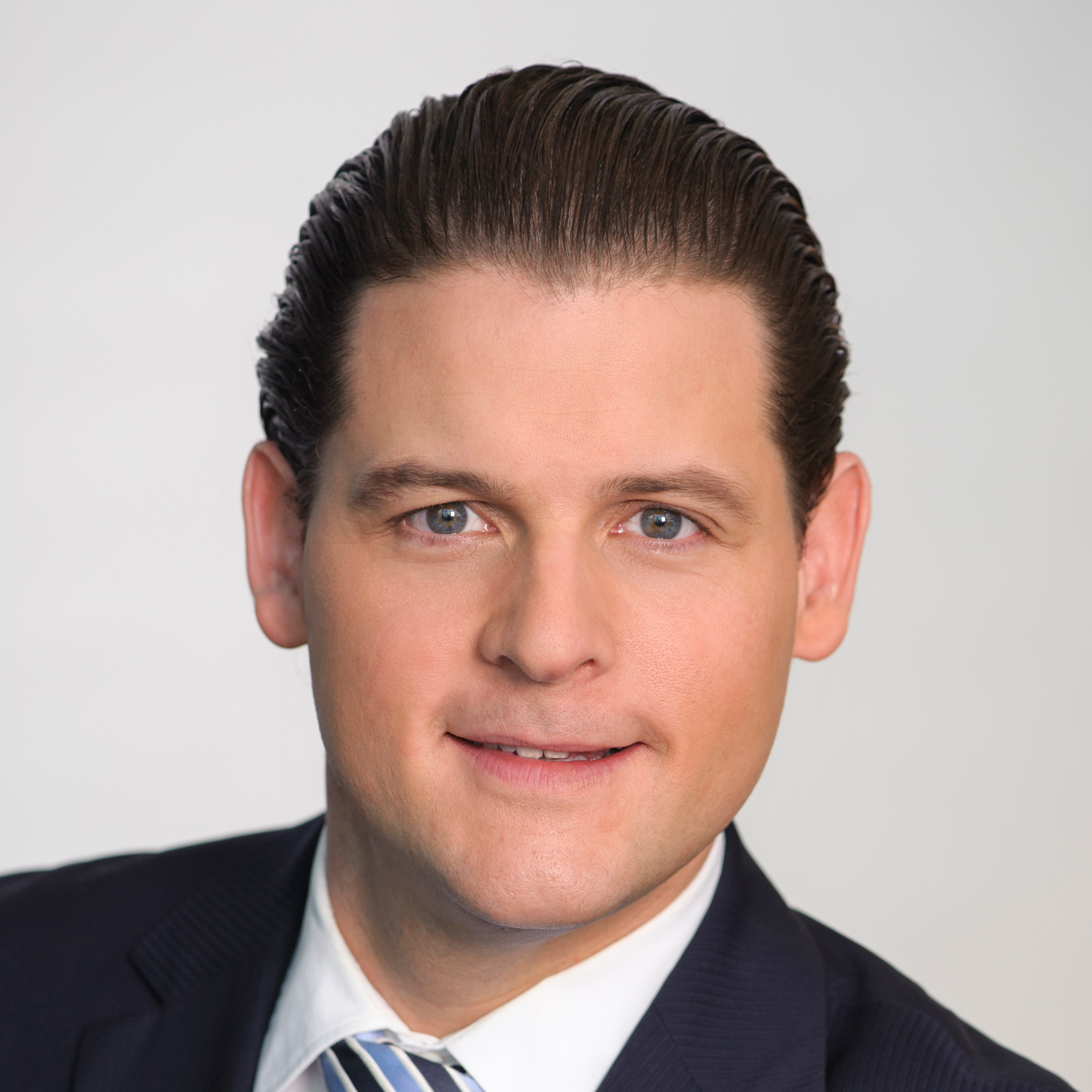
Georg Winter
CEO GrECo Group
T +43 664 962 39 06
Insured by Algorithms
The insurance industry is undergoing a profound transformation, driven by the rapid adoption of AI and predictive analytics.
Beyond Moving Cargo: Why Employee Well-Being Is the Real Asset in Logistics
In today’s employee-driven market, especially for Gen Z talent, benefits aren’t just perks – they’re strategic tools for attraction and retention
The New Edition of FORWARD Magazine Is Now Available
GrECo is proud to present the latest edition of our client publication, FORWARD Magazine—now live and ready to explore.