
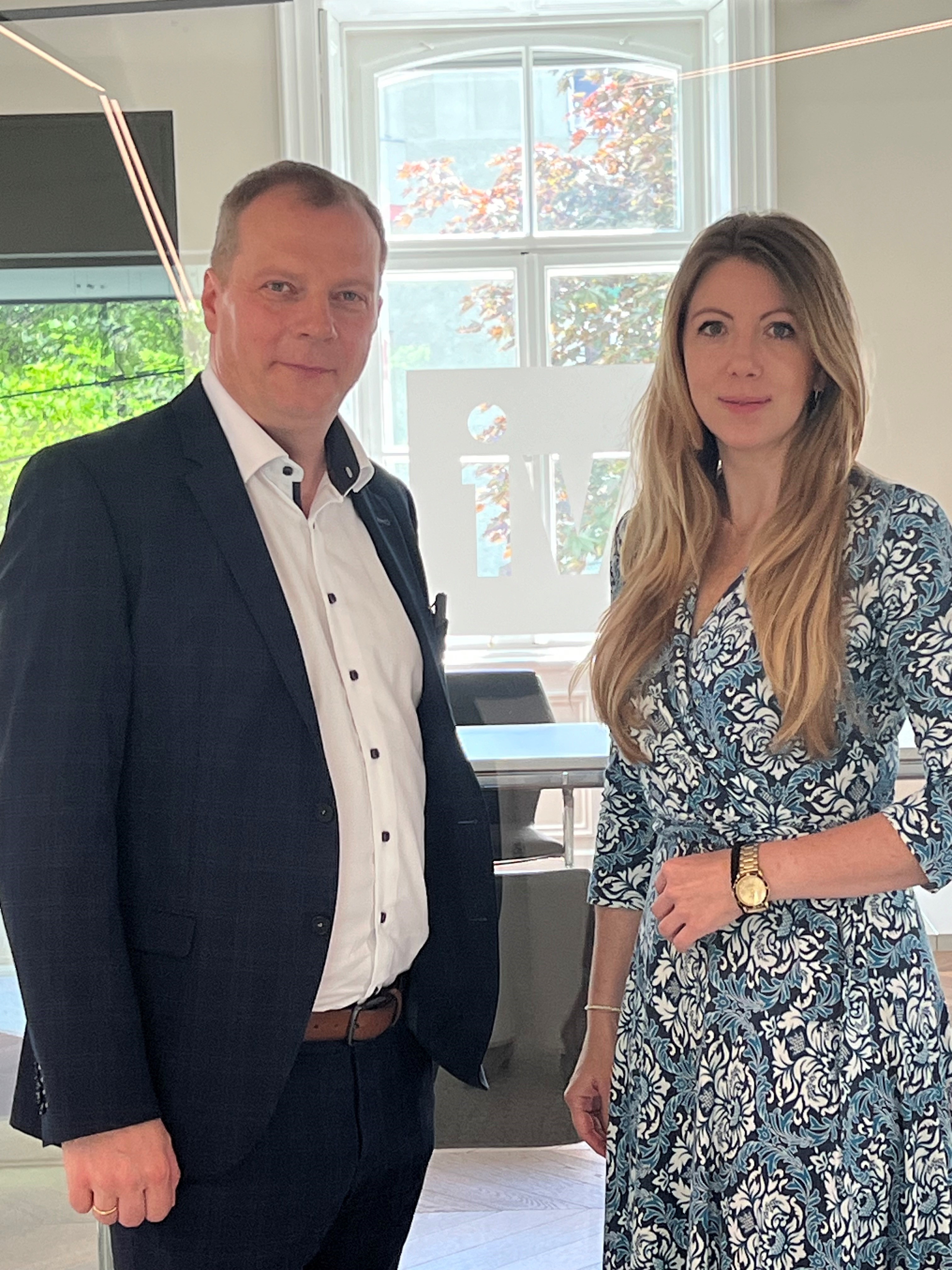
Jürgen Spari talks to Nina Zechner, Deputy Managing Director of the Federation of Austrian Industries Styria about the transformation of industry in the region, the growing presence of women in management positions, and why childcare is not just a women’s issue.
Is it a cliché to think women must work harder to succeed in male-dominated industries? Jürgen Spari, Regional Manager Styria, at GrECo Austria talks to Nina Zechner, Deputy Managing Director of the Federation of Austrian Industries Styria about the transformation of industry in the region, the growing presence of women in management positions, and why childcare is not just a women’s issue.
Spari: You are working very successfully in the heart of Styrian industry, in a male-dominated world at the Federation of Austrian Industries Styria (IV). How did this come about, and how do you feel about it?
Zechner: Industry is often seen as male-dominated. That may still be true to some extent, but it is undoubtedly becoming more female-centric. Today, a quarter of industrial apprentices are female, and there are increasingly more women in management positions or in prospective management positions. As in any other field, I am convinced that in the end it is about competence in what you do – regardless of gender.
Spari: Have you had to overcome challenges?
Zechner: I’ve been with the IV for ten years. Back then, I entered an environment where you had to assert yourself – regardless of whether you were a man or a woman. I don’t want to play into the old clichés that women must do more and more and that it’s harder and harder for them. I think any young person or young manager, male or female, will face similar challenges when entering an area that is already established. You must work for your career no matter what gender you are; and that’s how it was for me too. It’s by no means unique to industry, it’s simply the career path.
Spari: You have been working with Young Industry Styria for several years to improve work-life balance. In your opinion, what measures should politicians take to make it easier for women to return to work?
Zechner: The issue of childcare and balancing family and career is multifaceted. Gender aside, I think you have to offer both men and women the same opportunities when it comes to work-life balance, especially as more young men are deciding to take on a caring role.
Flexibility, availability, and affordability of high-quality services are essential. Above all, we need a wide range of services which are compatible with parents’ working hours. It is only possible to reconcile work and family life if it is possible to have children in the best care during working hours. I therefore think politicians have a lot to do in the childcare arena. They need to create the right framework conditions.
Spari: Are more measures needed to motivate men to take on more responsibility in family life?
Zechner: We need to pursue several approaches to make the compatibility of family and career a matter of course. I think this falls in to two distinct levels. Firstly, there is the individual level. We have to discuss with families how they can divide up the tasks and create a fair balance. Secondly, there’s the societal level. We need to finally move away from outdated patriarchal role models and adapt to the modern family of today.
I believe much still needs to be done in Austria to ensure childcare is no longer viewed as predominantly a female responsibility. This stereotype is also unfair to men, as it implies they aren’t trusted with childcare. Childcare is a family affair, and we need to change outdated mindsets and provide role models to achieve sustainability.
Spari: What steps are needed to support women CEOs in balancing motherhood, emphasising that they shouldn’t have to choose between their careers and starting a family?
Zechner: “Mum or CEO” is one of many headlines in our latest campaign “Our industry is rethinking”, which aims to show it’s not an either-or situation in Styrian industry. It is important to us to bring things into balance. We are firmly convinced that it is already “Mum and CEO” and we’ve some great examples in Styria where this is already true: successful women can and do manage full-time jobs and family life.
We need to clearly communicate to women and men that they can do anything and that they will receive the best possible support in their endeavours. Once again, it’s childcare that makes or breaks everything, because – without additional support from family – a full-time job is honestly not compatible with a full day at a kindergarten which closes at 4pm. Even if the child is well looked after from 8am to 4pm, you still need to allow for the commute, which leaves very little time to properly pursue a career.
A key aspect of this part-time issue is that the proportion of women in part-time jobs, at over 50%, is much higher than that of men, making it one of the highest figures in Europe. Childcare also plays a crucial role in connection with the shortage of skilled labour, and is not only important for mothers, but also for families, society, and industrial companies.
Spari: In this context, let’s also look a little into the future. When will we get to the point where it’s no longer mum or CEO, but parenthood or CEO and what do politicians need to do to achieve this?
Zechner: Ideally, in the future it will also be parenthood and CEO. I think what is needed above all is a change in social awareness, in which politicians can help to enable more flexibility and create more childcare facilities, and not just for children. Women also have to deal with the whole issue of caring for elderly relatives. This is quite common once the children have grown and don’t need as much care. Families are then faced with caring for aged relatives, a responsibility which mostly falls on women. There needs to be widespread awareness that both genders can equally fulfil this role effectively, and that there are specific external support services and new concepts available.
We need to rethink this topic: what it could look like if we were to reorganise it from the ground up?
International examples to learn from
Spari: Are there international examples, that we can learn from, where the issue of childcare in particular has been solved well?
Zechner: We often look to the classic Scandinavian examples where many things seem to work more organically. However, we also know that it took a long time for these countries to reach their current level of childcare. We exchanged ideas with Sweden a few years ago and it turned out that the impetus, this desire for more and better childcare, really came from society. At that time, Sweden faced a significant shortage of skilled labour, prompting society to recognise well-qualified women eager to work and contribute beyond childcare. This recognition sparked a movement that shaped Sweden’s current childcare infrastructure.
What’s more, it is also normal in Sweden for men to be involved in the childcare. Men get funny looks when they don’t pick up the children from nursery. Work-life balance is different in the Nordic countries because they have simply taken a different approach to it.
Spari: But that implies that Sweden has a significant advantage from the outset.
Zechner: They have simply taken a different path and therefore have a head start. Whether this is directly transferable to Austria is another question, but I genuinely believe things are moving in the right direction here. At Junge Industrie, we have been working intensively on this topic since 2018 and have come to realise that although we are only taking baby steps, we are happy to be on the move.
For us, the question is always: which comes first, supply or demand? We are big supporters of supply-induced demand and are convinced there must be sensible, high-quality afternoon care programmes in rural areas for them to be utilised. We often hear the argument that there is no demand at all for these services. Our reply is that of course there isn’t at the moment, because families have cobbled together a support network through friends or family, like grandma and grandpa to survive. However, we are certain there would be strong demand for comprehensive, high-quality services if they were readily available. We know around 40% of women who currently work part-time would like to work more but say they can’t due to their responsibilities caring for children and relatives. In view of the acute shortage of skilled labour, we need to be doing something about childcare to address the issue.
Spari: Let’s take a look at the side represented by the Federation of Austrian Industries. What measures do companies need to take to ensure this compatibility?
Zechner: I believe companies are already doing a lot. I mentioned the shortage of skilled labour earlier. This is putting companies under a lot of pressure and so they are already offering a host of benefits such as flexible working hours and company nurseries to make themselves more attractive.
For us, however, it’s crucial childcare remains primarily a public sector responsibility, and that companies, irrespective of their size or location, should not intervene in this domain. That said, if there are companies willing and capable of providing childcare voluntarily, it would be a valuable additional option.
Spari: Earlier, you mentioned women in part-time work. What does this mean in terms of the pension gap? Could benefits help close this gap and make employers more attractive?
Zechner: It’s important to consider that prolonged part-time work can have adverse effects. Besides the gender pay gap, there’s a notable issue with pension disparities. It’s crucial to raise awareness: If your contributions to the system are on a part-time basis, you may face disadvantages in the long run. In regard to this, there are interesting calculations which show what part-time work means over a lifetime. Many people don’t realise we’re talking about a loss equivalent to the price of a nice condominium in Graz! As such, I think it’s only fair to make this problem clear and transparent for part-time workers so they can make an informed personal decision.
Our industry is Rethinking” initiative
Spari: What are the aims of the Styrian Federation of Industry’s “Our industry is Rethinking” initiative? The slogans in particular are very concise and thought-provoking.
Zechner: Through our comprehensive, broad-based communication platform “Our Industry is Rethinking” we aim to show the people of Styria the progressive, sustainable, and socially committed nature of Styrian industry towards its employees. Through multiple campaigns, our first step was to address the issue of balance. We have been through turbulent times and, to be honest, have not yet fully recovered. We want to bring certain aspects back into balance. To do this, we first looked at the personal opportunities that companies offer their employees.
We focused on climate, innovation, and sustainability. The overarching idea was to show what the industry can do, what it stands for and how innovative it is. We want to do away with old clichés and emphasise the great companies in Styria; not only showcasing their services and products, but also demonstrating the responsibility they undertake across various areas, from climate protection to work-life balance.
Styrian industry is very diverse, and we want the people of Styria to be proud of their industry and also recognise that prosperity in our state is closely linked to industry.
Spari: What contribution does the campaign make to the “social” aspect of sustainability in ESG?
Zechner: As I mentioned earlier, we looked at various topics and one of them was “Mum or CEO”. We wanted to discredit the prejudice that women in industry cannot take on management positions if they want to have a family at the same time. To do this we showed many examples where this has proved possible, showcasing very personal stories. We focused on the people who give Styrian industry a face and illustrated how they navigate the delicate balance between career and family life, which in many instances is run-of-the-mill.
About Nina Zechner
Since January 2020, Nina Zechner has served as the Deputy Managing Director at IV Styria, having previously held the role of PR and press officer since April 2014. She studied communication science at the University of Salzburg and holds an MBA from LIMAK Austrian Business School.
About Federation of Austrian Industry Styria:
IV Styria represents a voluntary platform of industrial companies, advocating for their interests while promoting sustainable economic policies. Politically independent and dedicated solely to its members, IV Styria represents 80% of Styrian companies with over 250 employees. It fosters respect and social fairness in the region, aiming to set a model for sustainable economic systems globally.
Functioning as the voice of Styria’s industrial sector, IV Styria facilitates connections with political and administrative bodies at regional, national, and European levels. It organizes industry dialogues, supports education, innovation, and investment initiatives, and promotes a prosperous future for all in Styria through its steadfast commitment to excellence and progress.
About Young Industry Styria:
JI Steiermark is the young talent organisation of the Federation of Austrian Industries Styria and offers young and prospective managers in industry a platform for exchanging opinions and experiences.
HORIZON Risk Thought >> Fast Forward
The complexity of today´s risk environment is changing at an accelerating pace, making risk management even more challenging. We have created HORIZON, firstly as a print publication and now as a page for sharing the latest insights about ongoing transformations. Our risk specialists will continue to provide their expertise and knowledge to shine a light on the challenges of the future.

Nina Zechner
Deputy Managing Director
Federation of Austrian Industries Styria

Jürgen Spari
Regional Manager Steiermark
T +43 664 149 94 89