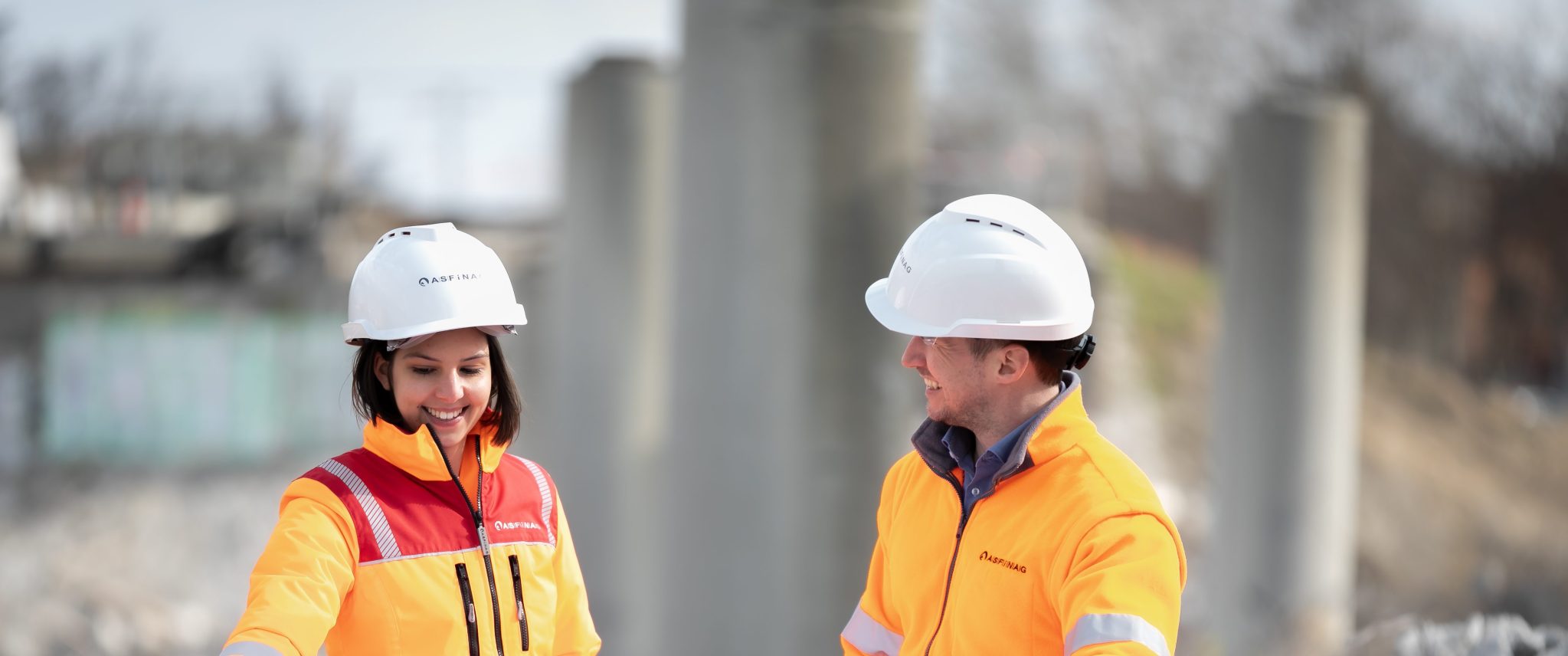
Brigitte Müllneritsch, Regional Manager Construction at ASFINAG Bau Management GmbH and Laura Hochegger, Executive Assistant – Strategy, Sustainability, Innovation at GrECo International Holding discuss integrating social criteria into public procurement tender requirements.
ASFINAG oversees the planning, construction, maintenance, operation, and toll collection for approximately 2,549 kilometres of Austria’s motorways and expressways. Committed to keeping Austria moving, this state-owned company has integrated social criteria into its public procurement tender requirements for nearly a decade. Today, Brigitte Müllneritsch, Regional Manager Construction at ASFINAG Bau Management GmbH, talks with Laura Hochegger, Executive Assistant – Strategy, Sustainability, Innovation at GrECo International Holding discuss the rationale behind this decision and its implications for service providers in the tender process.
Hochegger: Why Did ASFINAG Decide to Incorporate Social Criteria into Procurement?
Müllneritsch: You could say we’ve been spearheading the movement for building better workforces in our sector for nearly a decade. We began including social criteria in our procurement process in September 2015, long before the introduction of the Federal Procurement Act 2018 (BVergG 2018) which made it a requirement to integrate social considerations into tender processes.
Back then, we decided we wanted to promote fair competition and give preference to bids that emphasised social responsibility. We committed to encouraging companies to invest in apprenticeships, retain the valuable experience of older workers, train skilled professionals, and foster diversity within their project teams. We believe this not only enhances the overall quality and sustainability of the workforce but also provides significant incentives for the economy to thrive.
The rise of ESG requirements has really brought awareness of the need for greater socially balanced workforces to the fore in recent years. If we look to the not-too-distant future, the Corporate Sustainability Due Diligence Directive (CSDDD) will further intensify social responsibility in procurement. While we are also somewhat ahead in this regard, additional ESG considerations and stricter due diligence to ensure supplier compliance with social responsibility standards will mean we have to continue to adapt and evolve our procurement processes.
Championing Diversity, Safety, Education and Fairness through Procurement
Hochegger: What specific social criteria do you typically consider in tenders for service providers?
Müllneritsch: We receive tenders from service providers such as construction and specialised planners, local construction supervisors, project managers, and inspection teams – all of these are traditionally male-dominated industries. Gender parity in Austria’s construction industry is not common. As a result, our tendering process for service providers takes a progressive approach by including gender parity as an award criterion. This initiative has been in place for a while and carries a weight of 2% in the evaluation. Practically, this means that bidders can propose up to a 2% higher fee if they meet the gender parity requirement. For projects requiring two to three key personnel, a mixed-gender team is necessary to earn these points. For teams larger than three, full points are awarded if the team achieves a 50% gender balance, with partial points available through a linear scale for lower percentages.
We’ve integrated this criterion into all tenders that need more than two key personnel. Currently, about 25% of our bidders are incorporating this gender parity element into their proposals.
We’re determined to break the “construction is for men” cliché. And others are too. In recent years there’s been a surge in initiatives encouraging women to enter construction and engineering. Things are slowly starting to change as employers realise that with a balanced gender distribution in their workforce, they appear more attractive and modern.
Hochegger: Do these social criteria differ for construction tenders?
Müllneritsch: The criteria are different for construction tenders. At ASFINAG, we want to address the scarcity of skilled labour, capitalise on a rich pool of experience and varied viewpoints, and facilitate knowledge exchange within diverse teams. As such, we ensure that at least 15% of our award criteria in contracts over EUR 1 million are based on quality, with half focusing on ecological and social aspects. For instance, we offer points for employing older workers (30% of points for workers aged 50+) and apprentices (full points for 8% apprentice hours).
In 2023, we introduced more flexible working models as a criterion for local construction supervisors, who oversee costs, deadlines, and quality on-site for us. We now determine the number of local construction supervisors needed for each project phase based on the specific requirements of the construction site; for example, five supervisors for the on-site construction phase.
Previously, these roles required 100% on-site presence, limiting options to full-time staff only. Now, with our new tender regulations, bidders can offer a “pool” of supervisors, allowing part-time employees to participate and increase workforce flexibility. Additionally, we’ve implemented remote work options for tasks like invoice checking and contract processing, reducing the need for daily commutes and increasing employee convenience. These flexible working models promote inclusion and ensure career opportunities for parents, older workers, or students, for example.
Regrettably, accidents frequently happen on construction sites, and it’s likely that most construction supervision personnel will encounter injured workers at least once in their careers. Nevertheless, prioritising the safety of our workers is paramount for ASFINAG. To enhance a secure working environment, we also award points for having 40% skilled workers on-site and for implementing safety concepts to enhance occupational safety.
In addition to safety, fairness and fair pay are also important criterion for us. To combat wage and social dumping, we require a construction site pass for proper social insurance registration and necessary training. That way we combat underpayment and ensure fair competition.
Integrating Social Criteria into Public Procurement is a Balancing Act
Hochegger: What challenges are there when integrating social criteria into the procurement process and how are you overcoming them?
Müllneritsch: As with any transformation there are challenges but none of them are insurmountable. Perhaps the most complex is ensuring compliance with legal frameworks like BVergG2018. Any social criteria must be designed to align with national and EU regulations to avoid any potential legal disputes. We ensure we keep abreast of any changes in regulation and come up with dynamic ways to enforce the requirements in our procurement processes.
Objectivity can prove challenging too. How do you objectively measure and evaluate gender diversity or apprentice employment? As I mentioned earlier, we have answered that question by developing clear, quantifiable metrics and consistent evaluation methods through our points system. We find with this method it is easy for our suppliers to understand and present the information we need in a quantifiable way that’s easy for us to evaluate.
Money is always a concern in our industry and social criteria can easily increase project expenditure. At ASFINAG we realise that we as a procurer, and our suppliers, must work out effective ways to balance costs versus benefits. As such we weigh the potential improvements in workforce quality and sustainability with great care, balancing these factors against the long-term benefits of social responsibility.
Extra expenses may also arise due to the necessity of ensuring that service providers adhere to the agreed-upon social criteria throughout the project. Managing this effectively is really a challenge for us because it requires significant resources for robust monitoring and enforcement. We have overcome this challenge by introducing the construction site pass I mentioned earlier and by carrying out random onsite checks.
Lastly, shifting an industry’s mindset towards social responsibility is a gradual process but it is possible. Not all suppliers are immediately prepared or equipped to meet the necessary changes to comply with the social criteria in our procurement processes. For smaller companies, integrating social responsibility into their bids can strain resources that may not be readily accessible, which can reduce competition in the tendering process.
However, despite these challenges we have seen great social transformation in the industry compared to 10 years ago. Austria has been increasingly aligning its procurement practices with EU directives that emphasise sustainability and social responsibility and it is having a positive effect. Since 2015 we’ve seen a marked increase in bids including some element of social criteria. Looking at our most recent statistics, between 2015 and 2023 68% of the bids we received included apprentice employment, 79% older workers and 97% construction site ID cards.
We are committed to building our workforces of tomorrow and it’s exciting to watch the industry transform as equity and equality become more prevalent in the workplace.
About Brigitte Müllneritsch
Brigette studied Cultural Engineering and Water Management at the University of Natural Resources and Life Sciences, Vienna between 1997 – 2003. She has worked with ASFINAG since 2005 where she has been responsible for projects in the Vienna area, been Head of the Cluster Vienna Collection A23 and, since 2018, she has been the Regional Manager for the Vienna, A4 and A6 areas. In 2012 she qualified as a Master Builder.
About ASFINAG
ASFINAG is a federal company founded in 1982. They plan, finance, build, maintain, operate and pave almost 2,265 kilometres of highways and motorways.
The “ASFINAG system” is considered a best-practice example throughout Europe. This is because ASFINAG finances all its expenditure – from new roads to functioning winter road services and clean motorway service areas – solely from its own resources. They invest the toll revenue directly back into the infrastructure to improve safety even further. Simply put, this means that no money from the state budget is being used.
HORIZON Risk Thought >> Fast Forward
The complexity of today´s risk environment is changing at an accelerating pace, making risk management even more challenging. We have created HORIZON, firstly as a print publication and now as a page for sharing the latest insights about ongoing transformations. Our risk specialists will continue to provide their expertise and knowledge to shine a light on the challenges of the future.

Brigitte Müllneritsch
Civil Engineering and Water Management
ASFINAG Bau Management GmbH

Laura Hochegger
Deputy Head of Sustainability & Innovation
GrECo Group
T +43 664 822 18 66