The challenges facing Austrian agriculture are diverse and complex. Prok. Dr Mario Winkler, Head of Communications at Österreichische Hagelversicherung, talks with Laura Hochegger, Executive Assistant Strategy, Sustainability, Innovation at GrECo Group, about the alarming long-term ecological and social consequences of climate change and soil consumption in Austria. With the livelihoods of future generations at stake, can we afford not to make changes now?
Hochegger: In the future, where do you see the greatest challenges for domestic agriculture in terms of sustainability?
Winkler: Domestic agriculture faces several challenges. However, from our perspective as a comprehensive agricultural speciality insurer in Europe, the two biggest are climate change and soil consumption.
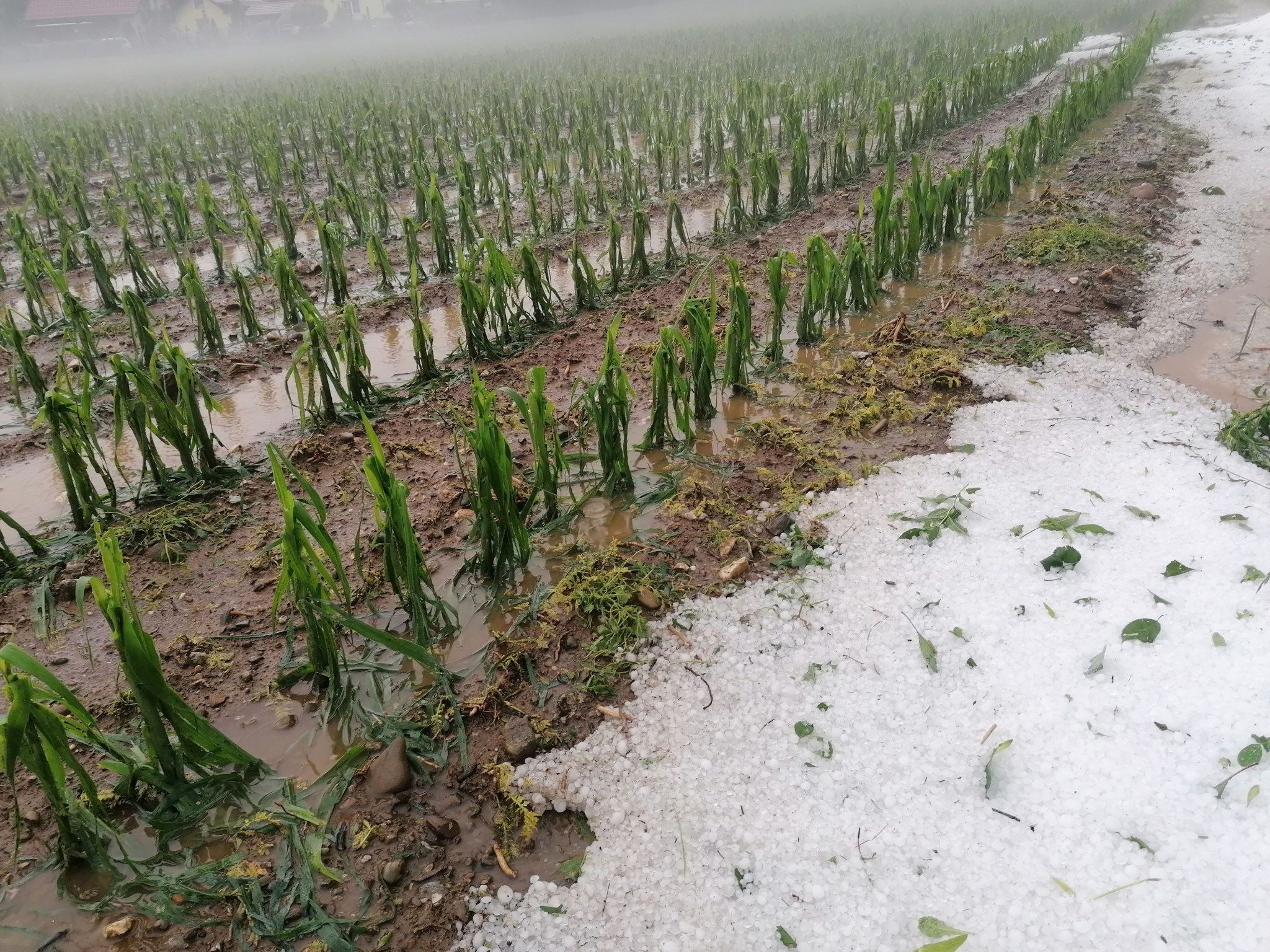
Why? Global warming is jeopardising agriculture due to increasing weather extremes such as frost, drought, hail, and flooding etc. And soil consumption, which is a national homemade problem, is the most pressing environmental issue in Austria at the moment because of the speed we are constructing on valuable agricultural land.
Ultimately, it is about securing the livelihood of future generations.
Austria is the worst for soil consumption and sealing in Europe.
Hochegger: With 11.3 hectares of land being built on every day – the equivalent of 16 football pitches – Austria is the European champion when it comes to soil consumption and soil sealing. What impact does this have on food security and what solutions do you see for curbing soil consumption?
Winkler: Austria is the European champion in a negative sense when it comes to destroying the soil on which we live. With 60 supermarkets per 100,000 inhabitants, we have 50% more than Germany, and are the leader in terms of road length with 15 metres per capita. In the last 20 years, 130,000 hectares of fields and meadows in Austria, equivalent to the arable land in Burgenland, have been sacrificed for construction projects. This includes 72,000 hectares of prime farmland alone. According to a WIFO study, this means that we will be able to feed 480,000 fewer people in Austria every year. If we carry on like this, in 200 years there will be no more agricultural land. This not only jeopardises our national food supply, but also leads to more flood damage, the extinction of animal and plant species, and the disfigurement of the landscape. The keyword in this explanation is food supply: We already have a low level of self-sufficiency in many areas. For example, we are 90% self-sufficient in bread grain, around 50% in fruit and vegetables, and only 30% in soya. So, as you can see, we are already very vulnerable. We need to realise this: We can’t eat concrete!
However, according to the experts, there are several possible solutions to curb soil consumption (as well as other issues): Firstly, we should replace the current federal states’ regional planning system with an independent body at federal state level. Secondly, municipalities that act in a soil-conserving manner should be rewarded through financial equalisation. Thirdly, the best agricultural land should be absolutely protected from further development and the high vacancy rate should be revitalised through financial incentives. Furthermore, we must utilise the right to direct democracy, such as referendums on major development projects, and make it clear that the old economic thinking from the 1970s “more concrete brings more prosperity” is obsolete. Because when it comes to soil, there is only one thing at stake: our future and the future of future generations. Soil protection is climate protection and therefore life protection!
Expansion as a response to climate change.
Hochegger: But it is not only soil consumption that has an impact on food security. Droughts in Austria now cause more damage than any other natural disaster. Drought damage is expected to quadruple by 2050. How can we counteract this?
Winkler: Drought is unfortunately, a very good, but negative, example. This accumulation risk now occurs every three to four years in this country. In Vienna, for example, we used to have around 10 hot days a year in the 1980s and 1990s, i.e. days with temperatures of more than 30°C, there are now almost 30 hot days a year – three times as many. 2023 will be the hottest year in the 257-year history of temperature measurements!
Global warming is also causing vegetation growth to start earlier in spring. This leads to increased frost damage in fruit growing and viticulture. Measures that can be taken in the event of frost include frost irrigation and fumigation, while in the event of drought – where technically feasible and profitable – irrigation or the cultivation of more heat-resistant crops such as millet can be used.
No matter what the issue is, in the long term, soil consumption must be stopped and more must be invested in climate protection overall.
So, what does this mean in insurance terms? More than half of the compensation for drought damage is already quite regularly being paid out . Broad reinsurance cover is therefore necessary, despite the fact we have recently seen many small reinsurers go out of business. However, to be able to continue to offer comprehensive insurance cover, it is necessary to diversify risks. We do this through the areas we insure. As the growth in area in Austria is limited, partly due to land consumption, we started expanding abroad in 2006 and are now active in five Eastern European countries – Czech Republic, Slovakia, Slovenia, Hungary, and Romania. Bulgaria will be added in 2024. This expansion is our response to climate change, with the aim of better risk diversification.
Eliminate the basic problems to continue to produce at all!
Hochegger: What other factors influence food security?
Winkler: In addition to climate change and soil consumption, food security is influenced by many other factors. Economic factors are important, including price fluctuations. The availability of water, resources, and soil quality are also further decisive elements. Social aspects such as population growth and urbanisation also influence food supply security. As you can see there are lots of factors, and whilst technological developments, such as innovative cultivation methods and modern storage technologies, are playing an important role in overcoming some of the challenges in food supply, the basic problems must be eliminated first to be able to produce at all: These are climate change and land consumption!
There’s also threats to animal husbandry which we haven’t yet touched upon. Global warming is causing certain animal diseases to spread across Europe that previously did not occur or hardly occurred at all in this region. This is due to the spread of mosquito species that are native to warmer climatic regions. Some examples of this are bluetongue and, for the first time since 2022, epizootic haemorrhagic disease, a ruminant viral disease.
In addition, other new pathogens are reaching us – for example African swine fever. This disease, which is harmless to humans but fatal to pigs, is spreading further and further, particularly in Eastern Europe. Fortunately, no case has yet been detected in Austria. However, it is advisable for farms to be covered by insurance because it’s likely to only be a matter of time.
Insurance is indispensable for farmers right now.
Hochegger: So, the threats to agriculture range from environmental impacts to demographic challenges. Are we already seeing trends in how farmers are dealing with these difficulties?
Winkler: The loss of a year’s harvest can easily threaten farmers’ livelihoods. No harvest means no income. Furthermore, we must not be misled by the historical or often “romantic” image of agriculture. We are talking about entrepreneurs with ever larger farms that produce food, and in view of the risks, they are relying on comprehensive operational risk provisioning. Most agricultural businesses are already insured with us. In total, these insured farms cultivate almost 85 per cent of the agricultural land in Austria! The diversity ranges from fruit growing and viticulture to arable farming, horticulture, vegetable growing, grassland management, and animal husbandry. What is clear is all farms, no matter what they are farming, have one thing in common: risk management in the form of insurance has become indispensable for securing their livelihoods.
Hochegger: What solutions can be used to counteract these challenges to food supply?
Winkler: A basic prerequisite when it comes to climate change is the fulfilment of obligations under international law, such as the Paris Agreement. But more efforts are also needed on a national level to protect the climate. One of the main problems in Austria comes from CO2 emissions from transport. Between 1990 and 2021, CO2 emissions from transport increased by 57 per cent. In the same period, CO2 emissions from agriculture were reduced by 16 per cent. Austrian agriculture is taking climate protection seriously and taking the necessary measures to help reach the Kyoto Protocol goals, but it is falling victim to extreme weather events driven by climate change which in turn is being impacted negatively by other industries. – it Agriculture is proving both climate protector and climate victim number 1!
All in all, what is abundantly clear is that in addition to increased awareness of the issue, soil consumption needs a comprehensive package of measures, as mentioned earlier, with quantifiable limits on daily land consumption. We need this to protect the environment and for the benefit of our future generations!
About Prok. Dr Mario Winkler, Head of Communications
Mario Winkler graduated as a Doctor of Veterinary Medicine in 2001. He then worked for the Austrian Chamber of Agriculture and for the European Commission, DG Agriculture and Rural Development in Brussels. In 2008, he joined the Österreichische Hagelversicherung as Head of the Animal Insurance Department. Mario Winkler also served as assistant to the CEO and deputy head of the branch in the Czech Republic, before becoming head of communications and marketing and press spokesman for the company in 2013.
dable living possible worldwide. We are #1 in brick production worldwide and in clay roof tile production in Europe, with over 200 production sites in 27 countries. Additionally, we are the leading providers of pipe systems and surface pavings in Europe.
About Österreichische Hagelversicherung
A specialist agricultural insurer, Hagelversicherung was founded in 1946 in Austria and is now also active in the Czech Republic, Slovakia, Hungary, Slovenia, and Romania. They specialise in weather risk provision for the agricultural industry in these regions, with a comprehensive product range, including hail, drought, flood, storm, frost and ten other risks.
Prok. Dr Mario Winkler
Head of Communications
Österreichische Hagelversicherung

Laura Hochegger
Deputy Head of Sustainability & Innovation
GrECo Group
T +43 664 822 18 66
Related articles
Superyacht Insurance: A Deep Dive into Protecting the World’s Most Prestigious Vessels
Insuring a 50-meter (or larger) vessel brings an entirely new set of risks, rules, requirements, and expectations.
Key Actions for CFOs: Addressing Risks in the Middle East Conflict
This article provides a concise overview of the critical areas finance leaders should review to ensure that emerging risks are properly understood, documented, and, where possible, transferred.
Meet Our International Team: Cristina Arapu
At GrECo Romania, we are proud to work alongside Cristina Arapu, a highly respected insurance professional with over 20 years of experience and more than 14 years with our company.