How technology will contribute to increasing resilience and why personal responsibility is an important part of risk management.
Increase in Uninsured Losses
The losses caused by climate change are increasing, and many of these losses are uninsured or insufficiently insured. Reinsurers such as Munich Re report rising loss amounts in 2024 due to natural disasters. Thanks to climate related incidents such as extensive flooding in Spain; Canada’s forest fires, hailstorms and floods; hurricanes Helene and Milton, the total economic losses last year amounted to over 320 billion USD, of which only 140 billion USD were insured. Shockingly, each of these mentioned climate events surpassed previous damage records, setting new benchmarks for the economic impact of extreme weather events.
The damage caused by natural disasters continues to increase in Austria too. According to calculations by Austrian economists, the extreme weather events in September caused overall economic damage of around 1.8 billion EUR. It is assumed that only around 40% of the damage was insured. Around 900 companies were directly or indirectly affected by the floods. More and more regions and risks are being categorised as uninsurable. Such events increase uninsurability in the long term.
Forecasting Climate Change and Extreme Weather Events
The fact is that climate change is one of the greatest challenges of our time. It is considered unlikely that climate change can be stopped completely. However, technological developments and artificial intelligence (AI) provide useful tools to anticipate the expected impacts. If risks are known, they can be managed in different ways. Companies can better prepare for future developments and thus increase their resilience.
Climate models help to predict extreme weather events such as floods, heatwaves and forest fires more accurately. They play a decisive role in climate risk and vulnerability analyses, which are already being used by companies and municipalities to identify future climate hazards and their economic consequences. These analyses are becoming increasingly important and should form the basis for strategic decisions and adaptation and protection measures.
Technology & Climate Research as a Game Changer?
The effects of global warming on humans and the Earth’s systems are not yet fully known, which makes it difficult to adapt to climate change and carry out accurate risk assessments. Climate research is however closing this knowledge gap by combining classic climate models and artificial intelligence. Machine learning identifies patterns and anomalies in complex data sets, while self-learning algorithms and regional factors refine models for accurate, locally adapted predictions. On this basis, targeted measures can be taken to minimise risk, for example by expanding climate-resistant infrastructure, further developing effective early warning systems or adapting insurance solutions.
AI in Action Against Floods & Co.
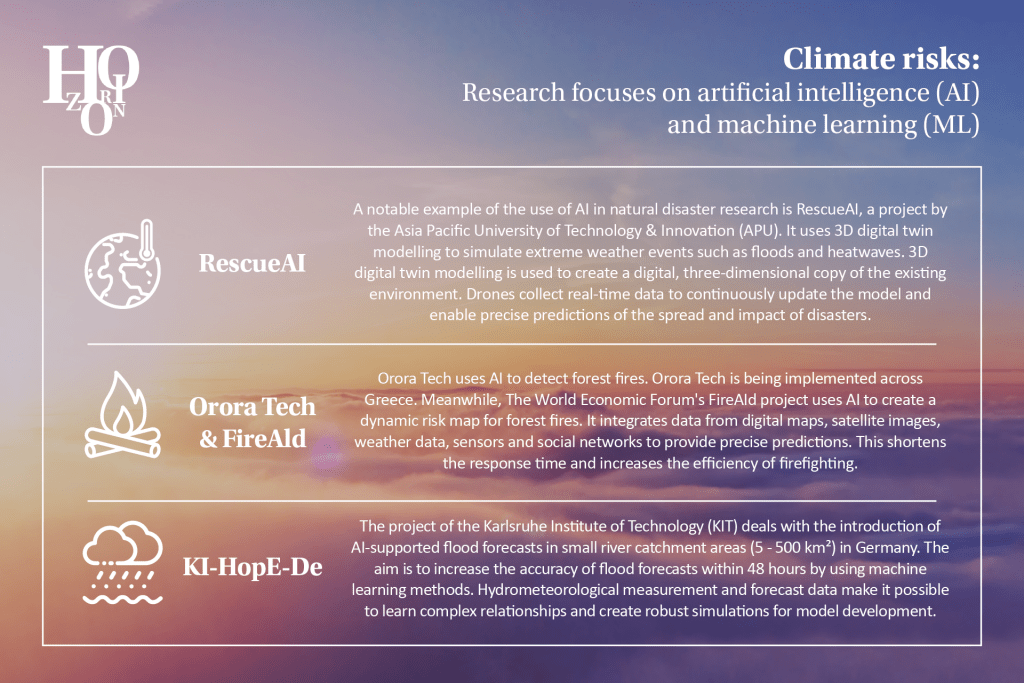
Flood risk: AI-supported systems analyse historical weather data, river level measurements and climate models to accurately predict floods. This allows companies and municipalities to develop evacuation plans, protect production processes, and take infrastructural measures like extending dykes or reinforcing drainage systems. Short-term rainfall poses a growing threat to settlements, infrastructure and human life, highlighting the need for accurate and timely forecasts.
Heatwaves: Analysing temperature and weather data using AI enables the early detection of heatwaves. It allows companies to adjust working hours and install cooling systems and municipalities to provide green or shaded areas to protect the population. AI also helps companies conserve energy and keep production running smoothly by optimising cooling systems in their production halls. Machine Learning (ML) algorithms further improve this process by predicting temperature trends and adjusting cooling mechanisms based on real-time data and weather forecasts.
Forest fires: AI models that analyse weather conditions and vegetation help companies to better protect their plants in fire-prone regions by activating measures such as fire watches and protective measures at an early stage. In communities, this can enable faster evacuation of at-risk areas and more efficient allocation of resources for firefighting. AI analyses real-time images from drones, satellites, and stationary cameras, as well as sensor data, to identify smoke development and fire sources with high accuracy. The system alerts local fire brigades immediately, enabling a rapid response. The data is analysed using specially developed algorithms for image processing and pattern recognition. These algorithms are trained to distinguish smoke from other natural phenomena, minimising false alarms.
Storms: AI systems use satellite data and weather forecasts to recognise the development of storms early. Companies can adjust or temporarily halt production processes to safeguard their workforce and equipment. Municipalities can coordinate storm preparations such as securing buildings and setting up emergency centres to ensure the safety of the population. In future, AI-based solutions will help predict infrastructure damage caused by natural disasters. By analysing real-time data and historical patterns, this new technology will anticipate potential damage from storms, for example.
The Importance of Personal Responsibility
When combatting the consequences of climate change, research and technology are crucial in adapting to and preparing for more frequent extreme events. These innovations also have great potential to revolutionise disaster management and significantly improve the safety and resilience of businesses and communities.
Despite technological progress, personal responsibility and risk-bearing are becoming increasingly important due to the growing un-insurability of environmental hazards. Companies, public institutions and private individuals must increasingly take independent measures to minimise risks and adapt to climate change.
Increasing resilience is the order of the day. Selecting safe building and commercial sites, along with investing in resilient infrastructure like flood-proof buildings or heat-resistant urban planning, helps to reduce risk. Efficient disaster response requires well-developed emergency plans, including automated evacuation systems, digital communication strategies, and AI-supported traffic management.
Although AI cannot stop climate change, it offers valuable tools for conserving resources, predicting and preparing for its consequences. By utilising data and machine learning, companies and societies can better respond to extreme weather events to save lives, mitigate the financial impact of climate change and develop effective adaptation strategies. In the long term, however, personal responsibility and risk-bearing capability will be crucial to address climate change challenges effectively.
HORIZON Risk Thought >> Fast Forward
The complexity of today´s risk environment is changing at an accelerating pace, making risk management even more challenging. We have created HORIZON, firstly as a print publication and now as a page for sharing the latest insights about ongoing transformations. Our risk specialists will continue to provide their expertise and knowledge to shine a light on the challenges of the future.

Andreas Schmitt
GrECo Austria
T +43 664 962 40 11

Martin Pöll
Risk Consultant
T +43 5 04 04 243