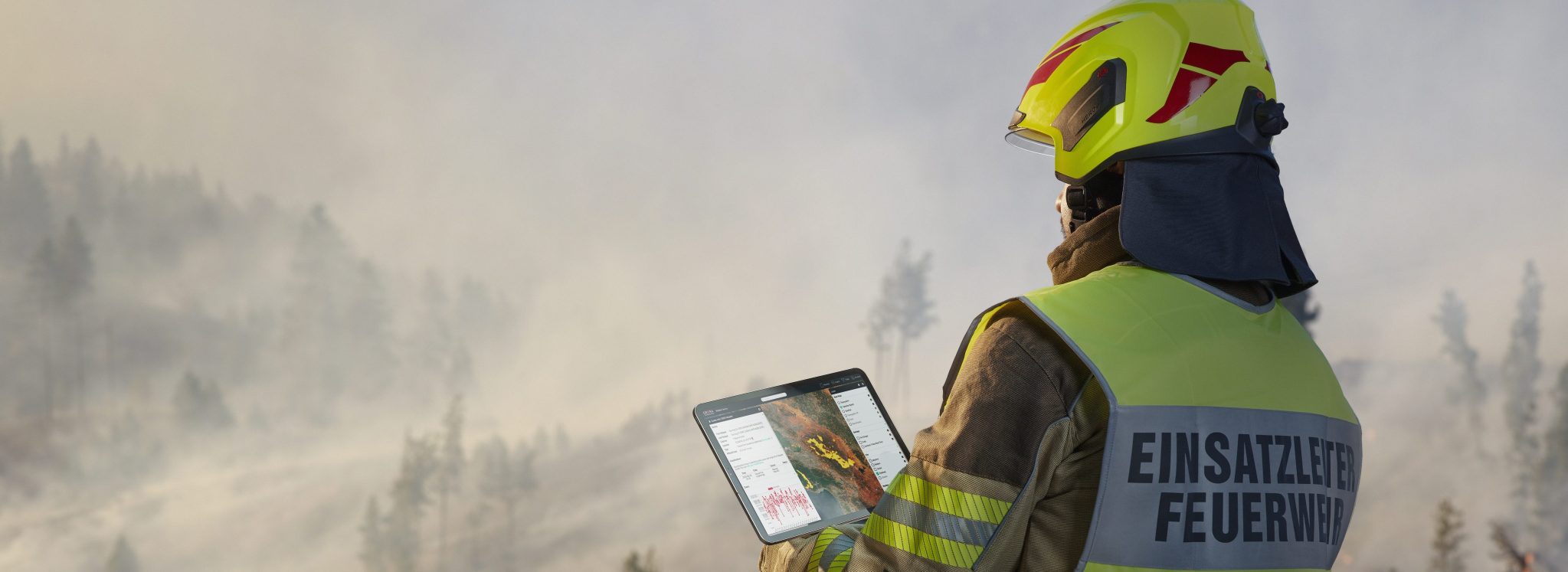
Rosenbauer Group is a thought leader and technology and innovation front-runner in the firefighting industry. Sebastian Wolf, CEO at Rosenbauer International, discusses with Argun Zia-Dam, Account Manager at GrECo, how Rosenbauer Group is blazing a trail in this industry and why cities in the future will rely on electrically powered firefighting vehicles.
Zia-Dam: Rosenbauer has combined sustainability with technological progress and innovation from the very beginning. How has it managed to actively fulfil its role as a thought leader in the firefighting industry for many years?
Wolf: The Rosenbauer Group is proud to be a technology and innovation leader in the field of preventive and defensive fire and disaster protection. We want to help sustainably develop our industry and be a leading light for others to follow. As such, research and development are of central importance to our group of companies.
For years, we have been systematically analysing the megatrends that are shaping our society because trend and future research serves as the basis for our future-oriented innovation work. In 2012, we created the first so-called fire service trend map, which is now available in its fifth, updated version. This trend map establishes a connection between the major megatrends and the fire service. It was the starting point for the development of our first fully electric fire engine, “Revolutionary Technology”.
Mapping today’s trends to make sustainable changes for the future.
Zia-Dam: Let’s take a closer look at the Fire Service Trendmap 5.0. Did the analysis of ecological, social, and economic megatrends play a part in its creation? What conclusions were drawn, and which insights were gained for the future of the fire service and civil protection sector?
Wolf: The trend map provides an overview of the most relevant changes and trends that have an impact on fire services, their areas of operation, work equipment, and tactics. It also outlines possible future scenarios and framework conditions that fire services will be confronted with. The content is regularly reviewed and revised in terms of its value. For example, the megatrends of neo-ecology, digitalisation, and social change are becoming increasingly important for the fire service sector. Let’s take a quick look at each in turn.
“Neo-ecology” is all about the climate crisis. As a result of climate change, natural events and extreme weather conditions will become more frequent and more severe and will affect larger areas of land than ever before. Increased forest fires and flooding will require comprehensive system solutions. Green pressure is also creating a new environmental awareness and as part of this fire services are increasingly being encouraged to rethink their approach to reducing emissions, energy supply, and the use of extinguishing agents.
Digitalisation and networking based on modern communication technologies are also playing an increasingly important role in the fire service. In both urban areas with well-developed infrastructure and in the countryside, for example, various data from sensors can be used to recognise critical changes at an early stage. This is entirely in the interests of fire prevention and more efficient deployment management. However, these new technologies can also be used for predictive vehicle and equipment maintenance, and the avoidance of critical technical failures.
And last but not least, social change will alter the fire services. On the one hand, this is about demographic change. We are all getting older; the average life expectancy in countries with a high per capita income is already 80 years old. At the same time, the proportion of older people in the population is increasing. Secondly, there are the issues of diversity and gender equality. Women have long been an indispensable factor in economic life and in the world of work, and they are also increasingly entering operational organisations. Together, these two factors will lead to a redefinition of functionality, and an adaptation of fire service vehicles and equipment so that these groups can also fulfil the requirements of the profession and their voluntary commitment.

Accompanying fire services into the age of electromobility.
Zia-Dam: Speaking of e-mobility, tell me more about the development of electrically powered fire engines, such as the “Revolutionary Technology”(or RT for short), now in use in cities such as Berlin, Vienna, Basel, and Los Angeles. What results have the fire services trialling them reported?
Wolf: The RT is our trail-blazing engine, and we won the 2021 State Prize for Innovation for it. This accolade is testament to our long-term group strategy “Rosenbauer City 2030” which positions the development and implementation of firefighting vehicles with alternative drive systems at its core.
Rosenbauer see it as its responsibility as an innovation leader to accompany fire services into the age of electromobility, actively driving this transformation forward and developing climate-friendly, state-of-the-art vehicles. And we’ve been doing just that. The first RT pre-series vehicles were delivered to selected lead customers – the Berlin, Dubai, and Los Angeles fire services – in autumn 2020. The practical results were convincing. Taking Berlin as an example: around 1,600 operations were carried out during the 13-month test period. More than 95 per cent of the missions were carried out purely electrically, far exceeding the target of 80 per cent. A diesel engine is now only used as an energy reserve in emergencies, for example when the equipment and machines onboard need to be operated over a long period of time.
The emergency services trialling the RT also praised its quiet electric motors and conference seating arrangement, and, according to the Berlin fire service, around ten tonnes of CO2 were saved during the test operation compared to operating a diesel LHF. As you can see, in this way, the fire services can actively support the sustainability management of city governments and make a significant contribution to the fulfilment of municipal climate protection targets.
Zia-Dam: Why is e-mobility such an important milestone in firefighting and what role will the vehicles in the electric line-up play in Rosenbauer’s portfolio over the next few years?
Wolf: In the next few years, more and more regions will be restricting the use of vehicles with combustion engines. From 2035, newly registered cars in the EU will either have to have an alternative drive system or run solely on e-fuels. There are also staggered fleet reduction targets for CO2 emissions for lorry manufacturers. The current trend is therefore clearly in favour of e-mobility, as there are no emissions on site and this technology is the most advanced. Rosenbauer’s e-mobility will make an essential contribution here.
The RT already combines many of the features that will be important in the fire service of the future: a highly ergonomic vehicle architecture, a low-emission drive, an innovative operating concept, and comprehensive connectivity. Today, we assume that every second vehicle we sell in 2030 will have an alternative drive.

Managing your own risks whilst helping others to manage theirs’.
Zia-Dam: You’ve created an impressive depiction of the future of the firefighting industry. How does Rosenbauer ensure that the changes in its own risk landscape are identified, evaluated, and managed?
Wolf: We use a system for risk management that enables a clear presentation of the risks and opportunities existing in the different sectors of the Rosenbauer Group. Business risks and opportunities are identified and recorded twice a year using a structured process, and risks and opportunities are assessed in terms of their likelihood of occurrence and their impact on the earnings.
The necessary control and management measures, as well as the instruments for risk management, are derived from risk analysis at an operational level. In addition, the results of the risk inventory are reported to the Audit Committee once a year.
One example of the individual risks identified around environmental and sector risks is global warming: in 2020, an analysis of climate-related risks and opportunities was carried out with the support of an external consultancy. The recommendations of the Taskforce on Climate-related Financial Disclosures (TCFD) were applied. The first step was to identify those climate-related risks and opportunities that could potentially be financially relevant for Rosenbauer. These were assessed in terms of their financial impact and how likely they were to occur. The physical climate risks for the production and assembly sites were identified as the main climate-related challenge, while the generally increasing demand for fire protection products and the opportunity for new Rosenbauer products and services were identified as the main climate-related opportunity.
Link to the fire brigade trend map 5.0: https://innovation.rosenbauer.com/de/#c20
About Sebastian Wolf
Since August 2022, Wolf has been the acting CEO of the Rosenbauer Group. Together with more than 4,000 staff, it is his ambition to bring Rosenbauer to the next level and to change the firefighting industry towards alternative drives and sustainability.
He started his career as a management consultant. In 2008 he joined Rosenbauer Group and between 2017 and 2022 he was their Chief Financial Officer.
About Rosenbauer Group
Rosenbauer is the world’s leading manufacturer of systems for firefighting and disaster protection. The company develops and produces vehicles, fire extinguishing systems, equipment, and digital solutions for professional, industrial, plant and volunteer fire services, and systems for preventive firefighting. With revenues of € 972.2 million and around 4,100 employees (as of December 31, 2022), the Group is the world’s largest firefighting technology provider.
This listed family company is in its sixth generation and has served fire departments for more than 150 years. A strong customer focus, innovative strength, and reliability are Rosenbauer’s key assets.

Sebastian Wolf
CEO
Rosenbauer International AG

Argun Zia-Dam
Account Manager
GrECo International AG
T +43 664 841 45 88
Related articles
How Stability and Sectoral Growth Are Reshaping Argentina’s Corporate Risk
Argentina is experiencing economic reorientation, greater regulatory stability, and increased investment across sectors.
Jetzt vorbestellen: Health & Benefits Studie 2026
Jetzt vorbestellen: GrECo Unternehmensstudie zu Health & Benefits
Insured by Algorithms
The insurance industry is undergoing a profound transformation, driven by the rapid adoption of AI and predictive analytics.