“Europe will win if we act together, instead of going it alone at national level. The industry of the future is digital, sustainable, and resilient with scalable technologies, but it needs courage, open data spaces and excellently trained talents.”
At a time when digital intelligence is shaping the sustainability agenda, the intersection of logistics innovation and European vision has never been more critical. Markus Jakob-Kaeferle, Deputy Competence Centre Transport & Logistics at GrECo spoke with Univ.-Prof. Dr. Fazel Ansari, Head of Production and Maintenance Management at TU Wien and Member of Management Board at Fraunhofer Austria, about how technology, circular economy, and ethics are shaping Europe’s role in the global tech landscape.
From factory to value chain
Jakob-Kaeferle: How is the view of logistics and production changing in your research?
Ansari: We no longer think exclusively in terms of factory boundaries, but along the entire value chain. Data-driven planning and optimisation are central to this – both for inbound and outbound logistics as well as supply chain management. The clear goal here is sustainable industrial development.
Our focus is therefore on shared logistics and positive impact production. While the former aims at the sharing of resources between stakeholders, the second is about how factories can actively contribute to society. So, it’s not just a matter of reducing the negative contribution, but of asking: What would be a positive contribution from factories? As major employers, factories can make social and economic contributions in addition to environmental contributions.
Practical examples from the circular economy
Jakob-Kaeferle: What does this look like in your projects?
Ansari: A concrete example from research is the condition assessment of used batteries and electrical appliances. When a coffee machine or battery comes back, we analyse its condition – using data analytics methods (including image processing and text mining) as well as expert knowledge. It can then be decided which circular economy strategy or whether recycling, reusing or remanufacturing makes sense. This decision is based on multimodal data and often has to be made individually or product-centrically. TU Wien is developing demonstrators for this purpose, for example in the pilot factory, while Fraunhofer Austria is supporting the industrial implementation.
Europe’s role and values in global technology competition
Jakob-Kaeferle: How does Europe compare to other regions on the global stage?
Ansari: In the frontier area, the USA leads (computing/cloud infrastructure, chips, foundation models) and China is scaling rapidly in AI, robotics and quantum computing. Europe counters this with a strengths-based strategy: rule-based and human-centred (according to the EU AI Act), data-sovereign ecosystems (Gaia-X, Data Spaces), and high-performance computing. At the same time, the EU Chips Act addresses semiconductor sovereignty with > €43 billion by 2030 and the 20% market share target. Our values are our competitive advantage. We promote human-centred AI and rely on explainable, interpretable algorithms.
Jakob-Kaeferle: How can Europe remain competitive?
Ansari: Foundation models are a beacon of hope – in Europe, high-performance providers (e.g. Aleph Alpha) are emerging alongside open data spaces. On this basis, we build functions ranging from predictive maintenance to logistics optimisation, i.e. application-oriented, industry-compatible AI with comprehensible governance.
Another topic for the future is the digital twin. Many still see it purely as a data hub; however, the decisive factor is the bidirectional coupling to the real plant and the planning system – i.e. a perception-decision-action loop in which the twin not only collects data, but also evaluates options for action, proposes (or executes) decisions and processes feedback. Building on this, we are developing the next stage, the Cognitive Digital Twin (CDT): a sense-think-act system with explainable, causal/probabilistic models, knowledge graphs and AI agents that quantifies uncertainty, continuously learns from feedback and operates human-in-the-loop within clear guardrails.
A plea for a holistic view
Jakob-Kaeferle: What enables successful transformation, and how can SMEs be included?
Ansari: Digital transformation alone is not enough. We need a triple transformation – digital, sustainable and resilient. This is where I see a special responsibility of science. Our approach must be grounded in facts, not activism with clear terms, verifiable methods and coherent communication between science, politics and industry – otherwise confusion will arise.
SMEs are the backbone of European industry, but they often have reservations about technology. We have to inform them, train them and take them with us. This requires simple, understandable solutions, otherwise we will lose them. Over-regulation is problematic because many regulations are well-intentioned, but not practical.
Quantum Computing & Green AI: A Look into the Future
Jakob-Kaeferle: Which technologies could further advance sustainability?
Ansari: Quantum computing could address key sustainability problems including the energy requirements of AI as well as complex optimisations in logistics, energy and production planning. However, industrial maturity is not yet available. In eight to ten years however, this could potentially be real gamechanger (probably in hybrid quantum classic approaches).
Green AI and digital sustainability are also gaining importance, with energy-efficient AI models, computing infrastructure powered by renewable energy and CO₂-conscious scheduling – as evidenced by energy per inference and emission factors.
Overall, we need to systematically consider the carbon footprint of AI systems – across training, inference, hardware lifecycle and data centres. Something which has not been sufficiently present in the public debate so far.
Europe must find its way – together
Jakob-Kaeferle: What is your final appeal?
Ansari: I remain optimistic. Europe will win if we act together, instead of going it alone at national level. The industry of the future is digital, sustainable, and resilient with scalable technologies, but it needs courage, open data spaces and excellently trained talents. If we think of it as European, the transformation will have a measurable effect.
About Univ.Prof. Dr.-Ing. Fazel ANSARI, MSc
Fazel Ansari is a mechanical engineer. He earnt his doctorate (with summa cum laude) in Computer Science from the University of Siegen in 2014. He joined TU Wien and Fraunhofer Austria Research GmbH in 2017, obtaining his Venia Docendi in Industrial Engineering in 2021. Since 2023, has led the Research Unit of Production and Maintenance Management at TU Wien’s Faculty of Mechanical and Industrial Engineering and serves as Head of Strategic Projects & Management Board Member at Fraunhofer Austria’s Center for Sustainable Production and Logistics.
HORIZON Risk Thought >> Fast Forward
The complexity of today´s risk environment is changing at an accelerating pace, making risk management even more challenging. We have created HORIZON, firstly as a print publication and now as a page for sharing the latest insights about ongoing transformations. Our risk specialists will continue to provide their expertise and knowledge to shine a light on the challenges of the future.

Markus Jakob-Kaeferle
Deputy Competence Centre Transport & Logistics
GrECo Group
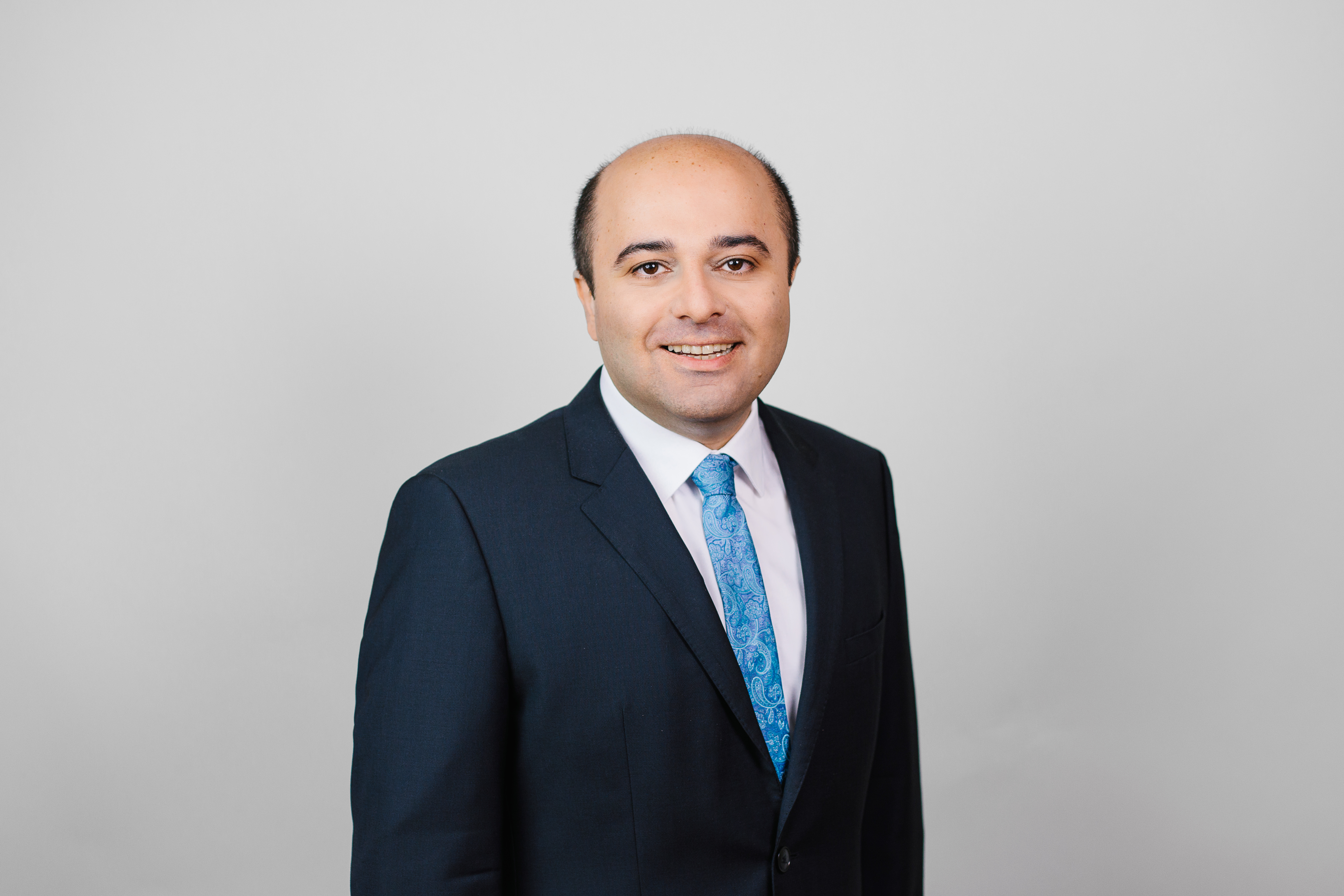
Univ.-Prof. Dr. Fazel Ansari
Head of Production and Maintenance Management
TU Wien