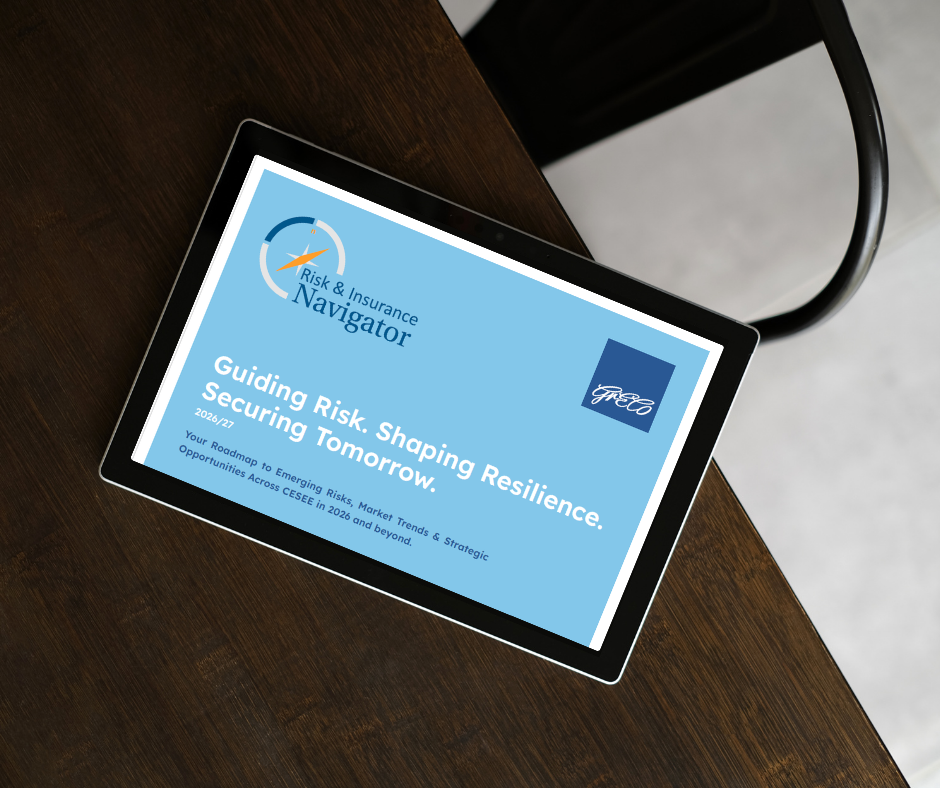

Georgia is often described as a bridge between regions, but in insurance terms it is something more exacting: a market where geopolitics, trade disruption and underwriting discipline meet in real time. In this conversation, Paul Johannes Spittau, Head of Group Carrier Relations & Insurance Mediation at GrECo Group, speaks with Levan Jishkariani, General Manager of GrECo Georgia, about what that means on the ground – from sanctions pressure and corridor risk to investment, insurability and the decisions clients need to take now.
Where the pressure starts
Spittau: Looking ahead to 2026–2030, which forces will matter most for Georgia?
Jishkariani: I think there are three really critical forces. The first is geopolitical tension, because Georgia sits on a strategic corridor and any shift in regional conflict or alignment can quickly affect trade routes, investor sentiment and political risk. The second is sanctions, which are becoming more sophisticated and are not only affecting value chains, payments, compliance and procurement, but also disrupting economic flows through blocked payments, lower export revenues and tighter constraints on financing and insurance. And the third is currency volatility across emerging markets, because in a country like Georgia it directly influences pricing, budgeting and cross-border trade, while also raising hedging costs and complicating claims settlements and reinsurance recoveries in foreign currencies.
How risk travels
Spittau: How is that reshaping corporate risk on the ground?
Jishkariani: Geopolitical developments are reshaping corporate risk very directly, and Georgia feels that quite sharply. Even businesses that operate mainly in the local market are affected through energy price shocks, supply-chain disruption, import delays and rising input costs. At the same time, cyber threats, disinformation and broader political fragmentation create new operational vulnerabilities, while any perception of higher political risk can weaken investor confidence, raise borrowing costs and reduce foreign direct investment.
Spittau: Where do you see that showing up most clearly across the key lines?
Jishkariani: These pressures are visible across all of the key insurance lines. In property, higher construction costs and delays in imported materials are pushing up insured values and premiums. In liability, underwriters are becoming more cautious around governance, environmental exposure and politically sensitive operations. In marine and cargo, Georgia’s role as a transit corridor means war-risk pricing, rerouting costs and transit transparency have all become more important. Political risk insurers are looking more closely at contract enforceability, currency transfer and expropriation triggers, while in trade credit we are seeing tighter limits, shorter terms and a stronger focus on financial transparency.
Where capital is moving
Spittau: Which sectors are drawing the most attention and what does that mean for insurance?
Jishkariani: The strongest investment interest is in transport and logistics, especially around ports, rail links and inland terminals. We also see strong interest in energy infrastructure, renewable energy and digital connectivity. That shift is affecting insurance demand as well, because clients are no longer only insuring fixed assets; they are also looking to protect cargo flows, supply chains, receivables, political risk exposures and access to markets. At the same time, the regulatory and policy backdrop matters a great deal, particularly the direction of EU–Georgia relations, sanctions compliance expectations, DCFTA obligations and any changes that affect foreign investment, customs or trade.
How the market is responding
Spittau: How are brokers, insurers and reinsurers adjusting and where are the gaps still obvious?
Jishkariani: Brokers, insurers and reinsurers are responding by becoming more analytical and more selective. Brokers are moving beyond placement into strategic advisory work, including scenario analysis, sanctions support and supply-chain stress testing. Insurers and reinsurers are asking for better data, stronger governance and clearer resilience planning before they commit capacity. At the same time, there are still service gaps, especially in political-risk forecasting, real-time supply-chain stress testing and integrated advisory that connects credit, political risk and multinational programme design.
A moment that changed the conversation
Spittau: Was there a recent moment when the market picture shifted in a way that was hard to ignore?
Jishkariani: A recent example was the debate around the Foreign Agents Law. It showed very clearly how quickly a regulatory issue can turn into a market-risk issue by affecting investor sentiment, increasing due-diligence requirements and raising broader concerns about Georgia’s external relationships. The main lesson for us was that political risk cannot be treated as something separate from operations, because it has a direct effect on contracts, trade, credit and insurability.
What 1 January 2027 could bring
Spittau: Looking ahead to 1 January 2027, what kind of renewal environment do you expect and what should clients be doing now?
Jishkariani: My view is that the 1 January 2027 outlook remains manageable, but specialty lines will stay under pressure. Marine, war-risk, political risk and credit insurance are likely to remain cautious and highly data-driven, while property may benefit from softer global reinsurance conditions, although limits around political violence and cyber-physical damage are still likely to remain strict. The most important thing clients can do now is strengthen their risk data, especially around supply-chain and corridor exposure, show clear governance and sanctions alignment, and review whether their insurance structures are still fit for a more volatile trading environment.

Paul Johannes Spittau
Head of Group Carrier Relations & Insurance Mediation
T +43 664 537 17 42

Levan Jishkariani
General Manager
GrECo Georgia
T +995577557474