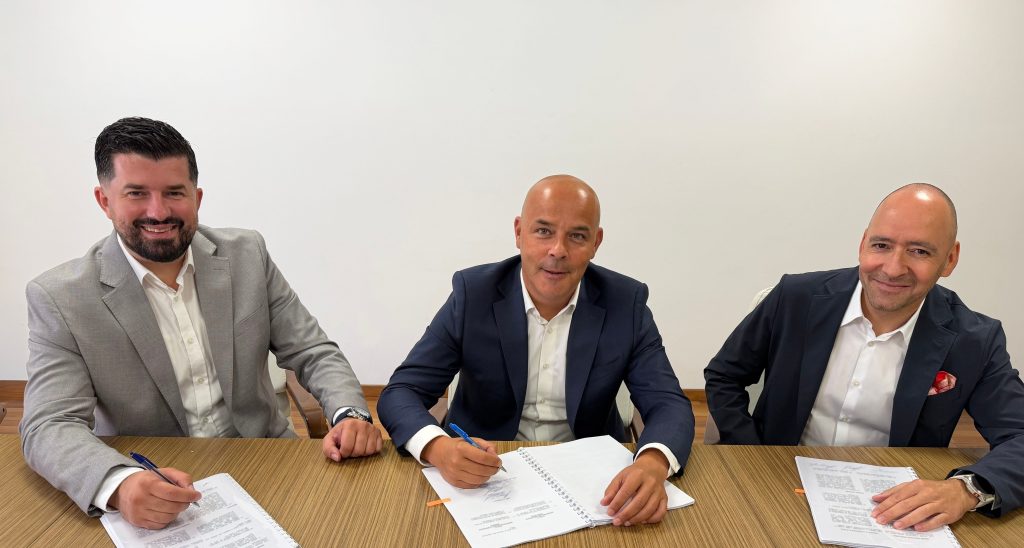

Jurgen Spari, Regional Manager Steiermark at GrECo Austria discusses with Christa Zengerer, Managing Director of ACstyria Mobilitätscluster, the future challenges and opportunities in the automotive, aerospace, and rail systems sectors. They discuss what mobility concepts of the future will look like and the role of digitalization in sustainable and innovative mobility solutions.
Future Gamechangers in Mobility
Spari: Through digitalization the mobility industry is seeing tremendous change. On ACstyria’s trend radar, which technological developments have the potential to be game changers in sustainable mobility within the next five to ten years?
Zengerer: ACstyria sees itself as a technology scout that recognises and evaluates technological developments at an early stage and makes relevant trends and developments accessible to its partners. Our aim is to ensure the competitiveness of the Styrian mobility industry and to support our partners in actively shaping the future of mobility. Our strategy reflects the five defined future fields for the Styrian mobility industry: digital business processes and models, automated systems, drive and vehicle technologies, materials, materials technologies and recycling management, as well as AI, electronics and software development.
Spari: How are member companies adapting to stricter environmental regulations and sustainability targets in the mobility industry?
Zengerer: Our companies and institutions are faced with the challenge of meeting increasing environmental requirements and ambitious sustainability targets in the mobility industry. They are meeting these requirements with a high degree of innovation.
One key success factor is the close networking of industry and science, which has been practiced in the ACstyria network for many years. The resulting R&D rate of over 12% in the cluster is a visible sign of the high level of innovation and consistent focus on future-oriented developments. Joint research projects, technology platforms and long-term partnerships with universities and non-university research institutions provide the basis for the rapid transfer of new solutions into industrial applications.
Digitalization Aids Sustainable Mobility
Spari: Are there differences in the automotive, aerospace, rail systems sub-sectors?
Zengerer: In the automotive sector, the focus is on the transformation towards alternative drives and the digitalization of vehicles. Innovations are taking place in very short cycles, which requires a high degree of flexibility on the part of companies. Topics such as CO₂ reduction, lightweight construction, battery and drive technologies, and automated driving dominate development. Companies are confronted not only with new market players, but also with new markets.
The aviation industry, on the other hand, is heavily influenced by safety-related requirements and long development times. Sustainability is driven primarily by the use of new materials, lightweight construction and the development of alternative propulsion systems, such as synthetic fuels. Due to the complex certification processes, the innovation process here is more elaborate, but also more predictable in the long term.
In the rail systems sector, the focus is primarily on increasing efficiency, optimising service life and intramodality. Thanks to its high environmental compatibility, the railway is benefiting greatly from the transformation of the entire mobility industry. Innovations here are focused on digitalization (e.g. predictive maintenance), smart control systems and new materials for weight reduction. Here, too, international networking is essential, but technological change tends to be more continuous than in the automotive industry.

A Delicate Balancing Act
Spari: What are the biggest challenges in terms of sustainability?
Zengerer: The primary challenges in sustainability revolve around balancing ecological goals, economic competitiveness, and technological feasibility. Key issues include decarbonising the entire value chain, adapting to changing legal frameworks, and embracing new technologies.
Digitalisation plays a crucial role, particularly in the automotive sector where innovations such as predictive maintenance, route optimisation, and logistics automation are transforming operations. Autonomous vehicles and AI are also pivotal, driving advancements in automated driving systems and intelligent mobility solutions.
Transparency in supply chains remains a significant challenge, requiring comprehensive tracking and documentation of sustainability criteria across all partners, which can be costly in international networks with complex structures.
Future-Proof Mobility Concepts
Spari: What do you consider to be the essential pillars of a future-proof mobility concept?
Zengerer: The mobility of the future is sustainable, digital, individual, and accessible and affordable for everyone. It’s also not just one mobility concept or one drive that will prevail. A mix of different concepts and drives that meet different requirements is the way forward.
Spari: How is the aerospace industry dealing with disruptions in the supply chain and cyber security threats?
Zengerer: There is a high dependency on safety-critical and complex components in supply chains, such as engines, with often only one qualified supplier worldwide. Bottlenecks arise if this supplier can’t deliver, as replacements require significant effort and long-term certification. Smaller components, like electronic parts, are comparatively easier to replace with equivalent suppliers. In the space sector, the situation is even more specific. Due to the high degree of customisation and the lack of series production, supply chains are extremely project-related and cannot be standardised, which makes it more difficult to secure additional capacities.
The aviation industry was quick off the mark when it came to cybersecurity, and high standards have been in place for over 30 years. There are two main scenarios to consider: firstly, the aircraft itself, which is well protected structurally by the consistent separation of safety-critical systems (aircraft domain) and passenger networks (passenger domain). Here, established, internationally coordinated security architectures are used and continuously developed.
On the other hand, the industry uses supply chains, where the implementation of cybersecurity measures is much more complex. The large number of partners, different levels of security and the globally distributed structure make it difficult to establish consistent protective measures. Holistic, scalable approaches are needed here – for example, in the form of binding security standards for the entire supply chain and awareness training for all parties involved.
The Role of Autonomous Vehicles and AI
Spari: What technological advances are the member companies of ACstyria focusing on in order to remain competitive in the mobility industry, and what role do autonomous vehicles and AI play in shaping the future of mobility?
Zengerer: Our companies are working on sustainable drive technologies, material innovations, digitalization, and also automated and intelligent systems.
Autonomous vehicles and artificial intelligence (AI) are considered to be the key technologies of the future which will fundamentally change our understanding of mobility. In cooperation with research institutions and technology partners, companies in the cluster are developing both components and subsystems for automated driving – e.g. sensors, actuators, control systems and safety architectures.
AI technologies are not only used for autonomous driving, but also in areas such as predictive maintenance, route optimisation, logistics automation and in the intelligent analysis of large mobility data.
Integrating New Technologies into Existing Systems
Spari: What challenges do you see in integrating new technologies into existing infrastructures and systems?
Zengerer: The integration of new technologies into existing infrastructures is one of the biggest challenges of the mobility transition. In many areas, there is a lack of interface standards, data compatibility or physical infrastructure, for example when retrofitting charging stations, sensor technology or communication systems.
One key obstacle here is the inertia of existing systems: infrastructure investments are long-term investments, and planning and approval processes are complex and time-consuming. New technologies such as automated driving, hydrogen propulsion or AI-supported traffic control therefore come up against existing structures that can often only be adapted with great effort – both technically and organisationally.
Spari: Are there particular challenges in the rail sector with regard to urbanisation and technological integration?
Zengerer: In the rail sector, increasing urbanisation and the high system complexity pose additional specific challenges. On the one hand, the demands on frequency, capacity and reliability in urban areas are increasing and on the other hand, new technological components such as digital signal boxes, automatic driving assistance systems or intelligent maintenance (e.g. predictive maintenance) have to be integrated into a tightly knit network that has often grown over time. International rail traffic also requires a large number of technical standards, the harmonisation of which is still faltering.
Spari: How should Austrian and EU politics promote innovation and ensure resilient supply chains, especially with rising chip demand due to electrification and software use?
Zengerer: Politics in Austria and at the EU level must create clear framework conditions that enable entrepreneurial action. Europe and Austria must become competitive again.
Spari: What role does ACstyria play in political discourse?
Zengerer: Since its founding 30 years ago, ACstyria has been a link between business, science and the public sector. In this role, it acts as a mouthpiece for the business community (over 300 companies and institutions) in their dealings with political decision-makers. Through direct cooperation with partner companies, ACstyria is able to identify the needs of companies and pass them on to relevant political decision-makers.
About Christa Zengerer:
Christa Zengerer, studied materials science at the University of Leoben and has held various leadership roles, including Managing Director of ACstyria between 2018 and 2022, and from 2024 to present day. She has significantly expanded the ACstyria network nationally and internationally, connecting business, science, and the public sector.
About ACstyria Mobilitätscluster
With a workforce of more than 70,000 employees and a total turnover exceeding 17 billion euros, ACstyria Mobilitätscluster is a prominent network based in Styria, Austria, representing over 300 companies in the automotive, aerospace, and rail systems sectors. Founded in 1995, ACstyria supports its member companies through networking and collaboration along the entire value chain.

Jürgen Spari
Regional Manager Steiermark
T +43 664 149 94 89

Christa Zengerer
Managing Director
ACstyria Mobilitätscluster