Continuity and Scenario Planning in the Shadow of the US–Iran Conflict

Johannes Vogl

General Manager GrECo Risk Engineering

3 Min Read

Given the fluidity of the US–Iran situation, companies should prepare multiple, distinct scenarios.

Read the full introduction to our series of articles on the Middle East conflict .

Early-Stage Uncertainty and Market Sentiment

As geopolitical tensions between the United States and Iran intensify, companies across Central, Southern and Eastern Europe must prepare for a period of elevated uncertainty. The conflict’s trajectory remains unpredictable and may shift rapidly – from limited hostilities to a prolonged confrontation or even a broader regional escalation involving key Middle Eastern actors.

In this environment, structured scenario planning and business continuity management (BCM) become essential tools for protecting operations, people, and financial performance. Below we outline a practical framework for CSEE businesses to anticipate impacts, strengthen resilience, and apply lessons from previous crises.

Building Scenarios in an Unpredictable Environment
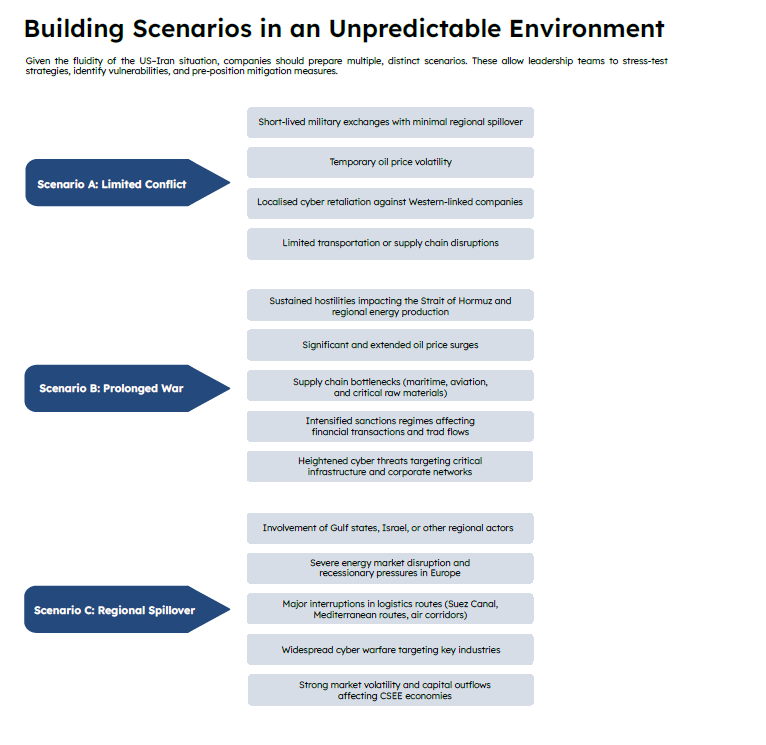
Given the fluidity of the US–Iran situation, companies should prepare multiple, distinct scenarios. These allow leadership teams to stress-test strategies, identify vulnerabilities, and pre-position mitigation measures.

Scenario A: Limited Conflict

Short-lived military exchanges with minimal regional spillover

  • Short-lived military exchanges with minimal regional spillover
  • Temporary oil price volatility
  • Localised cyber retaliation against Western-linked companies
  • Limited transportation or supply chain disruptions

Scenario B: Prolonged War

  • Sustained hostilities impacting the Strait of Hormuz and regional energy production
  • Significant and extended oil price surges
  • Supply chain bottlenecks (maritime, aviation, and critical raw materials)
  • Intensified sanctions regimes affecting financial transactions and trad flows
  • Heightened cyber threats targeting critical infrastructure and corporate networks

Scenario C: Regional Spillover

  • Involvement of Gulf states, Israel, or other regional actors
  • Severe energy market disruption and recessionary pressures in Europe
  • Major interruptions in logistics routes (Suez Canal, Mediterranean routes, air corridors)
  • Widespread cyber warfare targeting key industries
  • Strong market volatility and capital outflows affecting CSEE economies

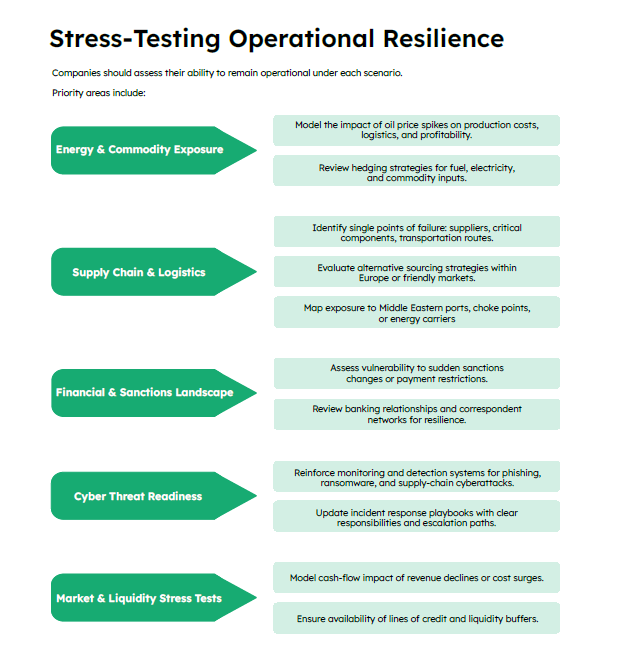
Stress-Testing Operational Resilience

Companies should assess their ability to remain operational under each scenario.

Priority areas include:

Energy & Commodity Exposure

  • Model the impact of oil price spikes on production costs, logistics, and profitability.
  • Review hedging strategies for fuel, electricity, and commodity inputs.

Supply Chain & Logistics

  • Identify single points of failure: suppliers, critical components, transportation routes.
  • Evaluate alternative sourcing strategies within Europe or friendly markets.
  • Map exposure to Middle Eastern ports, choke points, or energy carriers

Financial & Sanctions Landscape

  • Assess vulnerability to sudden sanctions changes or payment restrictions.
  • Review banking relationships and correspondent networks for resilience.

Cyber Threat Readiness

  • Reinforce monitoring and detection systems for phishing, ransomware, and supply-chain cyberattacks.
  • Update incident response playbooks with clear responsibilities and escalation paths.

Market & Liquidity Stress Tests

  • Model cash-flow impact of revenue declines or cost surges.
  • Ensure availability of lines of credit and liquidity buffers.

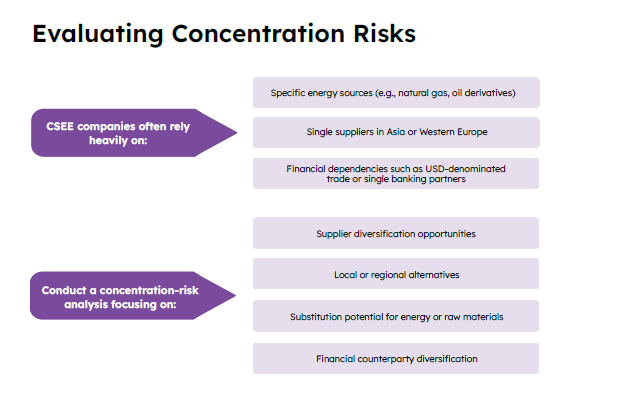
Evaluating Concentration Risks

CSEE companies often rely heavily on:

  • specific energy sources (e.g., natural gas, oil derivatives),
  • single suppliers in Asia or Western Europe,
  • financial dependencies such as USD-denominated trade or single banking partners

Conduct a concentration-risk analysis focusing on:

  • Supplier diversification opportunities
  • Local or regional alternatives
  • Substitution potential for energy or raw materials
  • Financial counterparty diversification

Learning from Past Crises: Structured Post-Loss Analysis

Companies should adopt a structured approach to learning from previous shocks whether the Ukraine conflict, COVID-19 disruptions, or earlier Middle Eastern crises.

Key Post-Loss Questions

What was the impact of previous crises on our business, and can we quantifWhat was the impact of previous crises on our business, and can we quantify the monetary loss?

  • Assess direct costs (e.g., damaged assets, increased logistics expenses).
  • Evaluate indirect costs (downtime, market exits, lost opportunities).
  • Quantify insured vs. uninsured losses to inform future risk financing

Which factors negatively influenced our business during past crises?

Consider:

  • supply chain breakdowns
  • energy price spikes
  • loss of skilled labour
  • cyber incidents
  • currency volatility
  • delays in cross-border payments
  • regulatory or sanctions changes

Which measures were taken to continue operations?

Examples include

  • relocating production or inventory
  • activating alternative suppliers
  • adopting remote work and digital processes
  • increasing safety stocks
  • emergency liquidity measures

Which measures proved successful – and which did not?

  • Document and benchmark effectiveness.
  • Identify inefficiencies, delays, or resource gaps.
  • Use findings to refine BCM policies and investment priorities.

What was the timeframe of the impact?

  • Track duration of disruption phases (initial shock → adaptation → recovery).
  • Use recovery timelines to strengthen preparedness for future crises.

Strengthening the Business Continuity Framework

To operationalise the above insights, companies in CSEE should:

  • Update Business Impact Analyses (BIAs) with new geopolitical scenarios
  • Integrate scenario testing into annual risk reviews
  • Run tabletop crisis simulations with leadership and functional teams
  • Update communication plans for clients, suppliers, and employees
  • Enhance insurance and risk financing structures, leveraging GrECo’s regional insights
  • Collaborate with external intelligence providers to monitor threats in real time

Preparing for What Comes Next

“Uncertainty in the Middle East will likely persist, and may intensify, in the coming weeks or months. Proactive scenario planning and robust business continuity strategies offer not just protection, but competitive advantage. Organisations that prepare early, diversify risks, and learn systematically from past disruptions will be better placed to navigate whatever comes next.” Johannes Vogl, General Manager, GrECo Risk Engineering.

Michael Brunner

Johannes Vogl

General Manager GrECo Risk Engineering

T +43 5 04 04 – 160

Related Industries & Solutions

Share this article

Related Insights

What sets leading companies apart is not a broader sustainability agenda, but a more strategic one.
This isn’t just about buying more coverage. It’s time to admit the industry has been doing this wrong – and having an honest conversation about what protection we actually need. 
If disruption only becomes real once it hits the core, you’re already too late.