
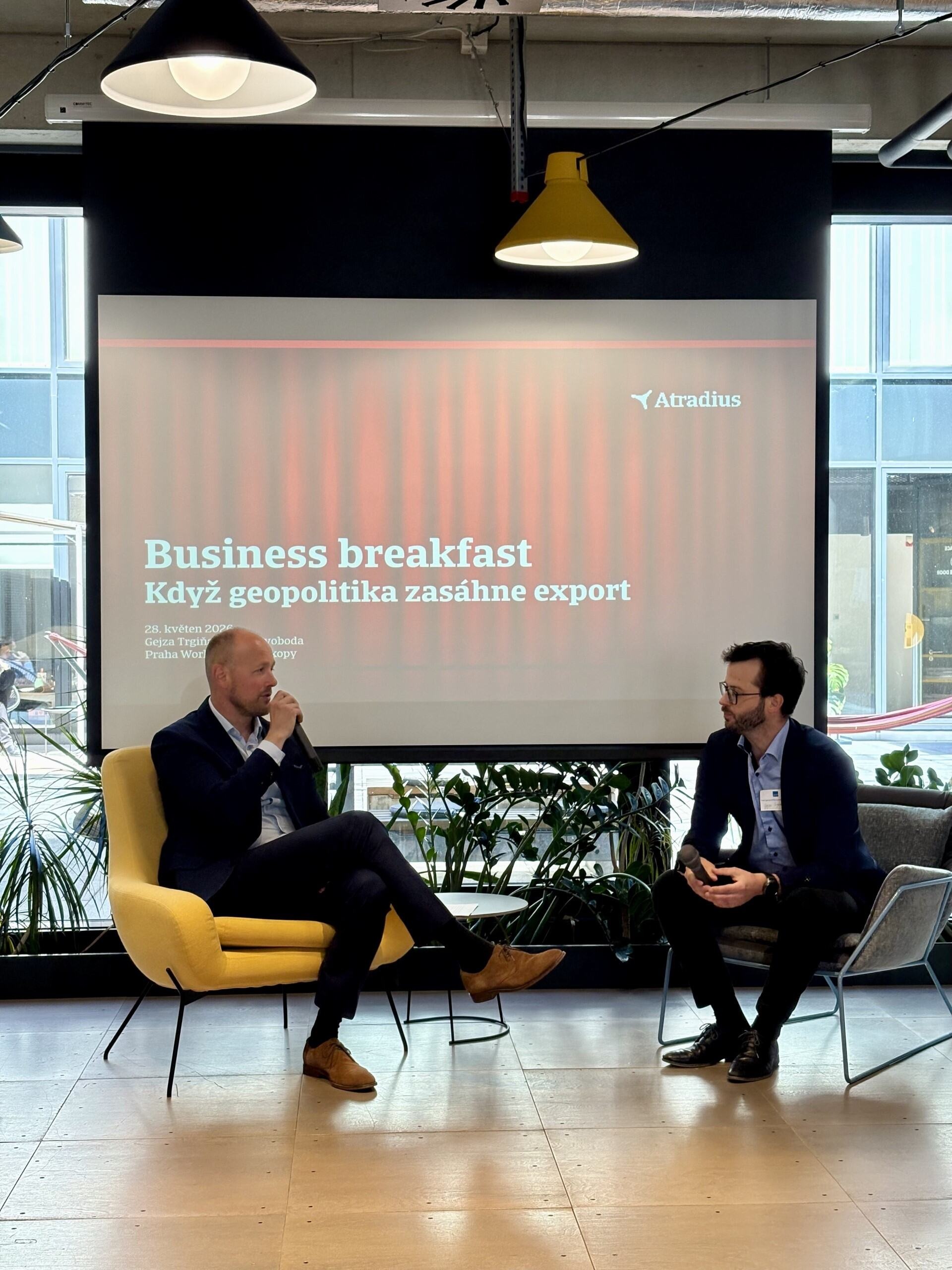
Lukáš Vodička, Group Practice Leader Trade Credit Specialties at GrECo Holding speaks with Gejza Trgiňa, Senior Underwriter at Atradius about what Czech exporters need to watch today and what it takes to build resilience when geopolitical unrest becomes a business issue, not background noise.
Vodička: Geopolitics was long treated as something happening somewhere in the background – important for states, perhaps, but only indirectly relevant for business. That no longer feels true. What has changed?
Trgiňa: Companies in the Czech Republic are increasingly dealing with situations where geopolitical events directly affect costs, business relationships and the ability to plan. The key question is no longer whether geopolitics matters, but where ordinary business risk ends and political risk begins, and, above all, how companies should realistically work with that reality.
Vodička: Risks can no longer be separated so neatly. Why is that so important for companies to understand now?
Trgiňa: Because things which used to be handled separately such as business, finance or compliance, are now tightly interconnected. Geopolitical events have an immediate impact on energy prices, the availability of inputs and the functioning of supply chains. Sanctions regimes and trade barriers are increasingly used as tools of geopolitical pressure, not just economic regulation.
That means one thing for companies: it is no longer enough to just monitor their own market or industry. They need to follow the broader context and understand how the different pressures interact. That is where the courage to transform starts, accepting that resilience today depends on seeing the whole picture, not just your own corner of it.
The End of Efficiency at All Costs
Vodička: For years, business was built around efficiency, and technology helped push that model even further. Has that logic now reached its limits?
Trgiňa: Definitely! For years business was built on maximum efficiency including optimised processes, globally diversified production and just-in-time models. But in an environment where rules are changing faster than ever before, resilience matters more than absolute efficiency. Dependence on a single supplier, region or technology can become a critical risk very quickly, which is why more companies are rethinking supply chains, looking for alternatives and working with options that reduce vulnerability.
Technology is sharpening that further by increasing efficiency and opening-up new opportunities, as well as also creating new dependencies and risks. Companies are heavily reliant on technology platforms from a limited number of global players, so regulatory or policy shifts can directly affect how they operate. Artificial intelligence is also changing the nature of cyber threats with attacks being faster, cheaper and more scalable. That’s why cybersecurity is no longer an IT topic, but a business risk with the same potential impact as a supplier outage or an unpaid invoice.
Where Exposure Shows up First
Vodička: Where does all this become most tangible for companies, and where are they still most exposed?
Trgiňa: Payment behaviour, partner stability and day-to-day decision-making are where it becomes most tangible. Volatility, cash-flow pressure and uncertainty are leading to longer maturities, weaker payment discipline and, in some segments, more insolvencies. At the same time, many companies remain unprepared, with decision-making still too reactive. The old shortcut of thinking ‘risk region equals problem’ no longer holds. Some geopolitically complex markets remain stable, while others that appear safe begin to show higher risk. That is why continuous partner monitoring matters. It is not enough to assess risk only at the start of a relationship. Companies need to respond as conditions change, before vulnerability and costs rise.
What Resilience Looks Like in Practice
Vodička: So, what does a more practical, more resilient response look like for companies that do want to act?
Trgiňa: It doesn’t have to be complicated, but it does require a more systematic approach. Companies need to stop treating geopolitics as external noise and start building it into management, using scenarios to prepare for different paths and react quickly as conditions change. Diversification matters more too, not just across suppliers, but also across markets and technologies, alongside stronger internal resilience through reserves, processes and the way cooperation is set up. Just as importantly, risk management tools need to work together. Internal measures, financial security and insurance are most effective when combined, and when companies make those shifts before the pressure becomes unavoidable.
Vodička: If companies want to stay ahead of this, what do they need to change now?
Trgiňa: The priority is to accept that geopolitics is now a standard part of the business environment, which means building it directly into management, working with scenarios, and diversifying across suppliers, markets and technologies while strengthening internal resilience through processes, reserves and cooperation. Companies that do this early and systematically will react faster, manage risk better and maintain greater stability, especially when they combine internal measures, financial security and insurance rather than relying on a single solution.
About Gejza Trgiňa
Gejza Trgiňa is a Senior Underwriter at Atradius. He holds a master’s degree in economics, with a focus on finance, auditing and financial engineering, and has worked at Atradius for more than 10 years. He specialises in the energy, fuel, gas and construction industries.
About Atradius
Atradius is a global trade credit insurer offering insurance, debt collection and business information services, helping companies manage risk, protect cash flow and trade confidently across international markets.

Lukáš Vodička
Group Practice Leader Credit & Political Risk
T +420 602 758 694

Gejza Trgiňa
Senior Underwriter
Atradius