HORIZON Risk Thought >> Fast Forward

Unsere HORIZON-Initiative war schon immer ein Wegweiser für alle, die es wagen, im Geschäftsleben neue Wege zu beschreiten. HORIZON ist eine Plattform, auf der Grenzen verschoben werden und die Zukunft mit Klarheit und Entschlossenheit angegangen wird.

HORIZON Risk Talks

Die Welt verändert sich. Wie reagieren Unternehmen darauf? In HORIZON Risk Talks teilen Expert:innen und Führungskräfte ihre Perspektiven auf Transformation und die daraus entstehenden Risiken und Chancen.

Wir haben HORIZON ins Leben gerufen, um die neuesten Erkenntnisse über aktuelle Veränderungen zu teilen.
Unsere Risikospezialist:innen stellen ihr Fachwissen und ihre Kenntnisse zur Verfügung, um die Herausforderungen der Zukunft zu beleuchten.

Entdecken Sie ihre neuesten Erkenntnisse, Gedanken und Standpunkte oder wählen Sie aus unseren systemischen Risikokategorien, um mehr zu erfahren. Die Inhalte basieren auf dem gebündelten Wissen unseres internationalen GrECo Netzwerks. Aus diesem Grund sind einzelne Beiträge in englischer Sprache verfasst; ergänzend stehen weitere Artikel in deutscher Sprache zur Verfügung.

How technology will contribute to increasing resilience and why personal responsibility is an important part of risk management.
In einer Zeit, die von geopolitischen Umbrüchen, wirtschaftlicher Volatilität und zunehmendem ökologischen Druck geprägt ist, sehen sich österreichische Unternehmen mit einem immer komplexer werdenden Risikoumfeld konfrontiert.
Kann KI jemals das menschliche Urteilsvermögen vollständig ersetzen? Und vielleicht am wichtigsten: Wie können KI und menschliches Fachwissen sich gegenseitig ergänzen, um die Cybersicherheit zu stärken?
Ist es ein Klischee zu glauben, dass Frauen härter arbeiten müssen, um in männerdominierten Branchen erfolgreich zu sein?
Im Gesundheitswesen sehen viele Ärztinnen und Ärzte sowie Pflegekräfte KI als vielversprechendes Instrument, um ihre hohe administrative Arbeitsbelastung zu verringern, und erwarten mit Spannung weitere Fortschritte.


In an era where artificial intelligence is woven into every aspect of business, the hidden dangers of unsanctioned AI tools are increasingly coming to light.
During a recent panel discussion organised by GrECo Czech Republic, experts in insurance and cyber security examined the most critical cybersecurity challenges and strategies.
The insurance industry is undergoing a profound transformation, driven by the rapid adoption of AI and predictive analytics.
Within healthcare, many doctors and nurses see AI as a promising tool to ease their heavy administrative workload and are eagerly anticipating further advancements.
Other crises, the climate crisis being a prominent example, are more likely to emerge as developments that gradually manifest themselves.
An effective risk management process is a basic requirement for tackling transformation risks.
Companies are exposed to various kinds of risks. At the same time, systemic transformation exacerbates existing risks and causes new risks to emerge.
Insurers are faced with a challenge during the energy transition. The past loss experience can no longer be used for predictive scenarios. New risks will emerge.
Comprehensive risk analyses combined with a presentation of the risks will be necessary for a successful renewal.
Amongst those most affected by decarbonisation efforts is the financial services industry, such as equity investors, lenders and insurers.
New modelling and technical tools are being utilised more than ever as insurers want to understand the complex technicalities of cargo risks.
 The insurance sector has adopted the ESG targets with every company developing an ESG strategy. The sector is particularly affected by climate change,
The prevention of damage from severe weather events will play an important role in future risk management.
Jürgen Spari spoke to Georg Knill about the challenges of the energy transition for the industrial sector and the impact of the Russia-Ukraine conflict on domestic companies.
Europe needs to cover gas demand with alternative sources. The EU energy security is compromised if there is no diversification to cover Russian gas imports.
Since the outbreak of the Corona pandemic two years ago, disrupted supply chains have threatened the existence of many companies.
The value of intangible relative to tangible cor­porate assets has steadily increased. Emerging risks threaten the value of both tangible and intangible assets.
With new insurers having entered the market in the past few months, we should see a dampening of the price increases we experienced in the previous two years.
On average, premium rates are expected to increase between 5% to 10%, even for policies with a no-claim history.
An interview with Martin Cerny and Jörg Schönenborn, Telecommunication Executives, and Andreas Schmitt, Insurance Professional.
In the last two years, supply chains were exposed to unforeseen risks. The impact of the pandemic, Evergiven’s blockade of the Suez Canal, or the recent disruptions as a result of Russia’s attack on Ukraine, to name a few. What else must we prepare for?
In HORIZON Risk Talks teilen Expert:innen und Führungskräfte ihre Perspektiven auf Transformation und die daraus entstehenden Risiken und Chancen.
Many hidden vulnerabilities can be unearthed if you are a bit creative. The key question is: can we live with the outcome? And then you need to give an honest answer.
Where does AI fit into the current policies as it stands, and what could the likely issues be?
We spoke with three leaders from different industries about energy independence in Europe.
 Paul Johannes Spittau explores transformation with Olivera Böhm-Rybak, Chief Corporate Business Officer International and CEO of UNIQA Sustainable Business Solutions.
The most significant failures may not arise from technical problems alone, but from adopting AI without clear responsibilities, controls and decision boundaries.
For Vienna Airport, the value of AI lies less in individual flagship projects. Its real impact comes from the cumulative effect of many operational improvements.  
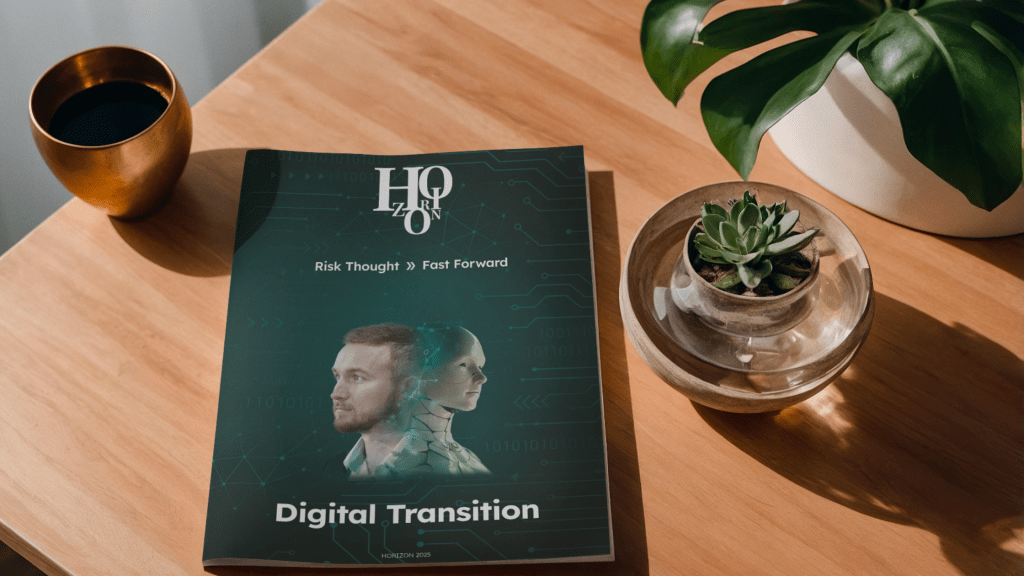
We are excited to announce the release of the 5th Horizon Risk Thought » Fast Forward publication!
In this exclusive interview, we bring together two leading voices on digital transformation in Central and Eastern Europe: Ursula Deschka, CEO of ERGO Baltics and Georg Winter, CEO of GrECo Group.
Peter Papp, sat down with Peter Bešina, founder of Paralla and Cryptodiggers, to discuss the evolution of cryptocurrencies.
Fear appeal is a common tactic to highlight the dangers of unsafe cyber behaviour in many cybersecurity awareness campaigns.
One practical application of AI is in the digitalization of HR processes. Tasks such as document management and onboarding can be streamlined, reducing errors and saving time.
Excessive reliance on devices is leading to “digital dementia,” a rise in memory lapses, diminished focus, and cognitive fatigue – even among youth and the workforce.
Digital transformation is reshaping higher education, but what does that really look like for universities on the ground?

Tauchen Sie tief in unsere HORIZON-Printausgabe ein, die sich auf verschiedene Transformationen konzentriert und alle damit verbundenen Herausforderungen aus unterschiedlichen Blickwinkeln betrachtet.